Te Whāriki · Aotearoa New Zealand
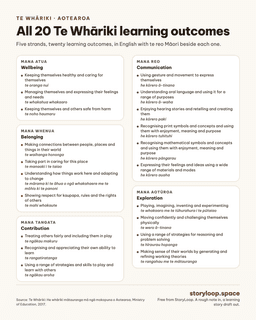
Te Whāriki learning outcomes, all 20 by strand
Te Whāriki (2017) has five strands, each with goals for kaiako and learning outcomes for children, 20 learning outcomes in all:
- Mana atua | Wellbeing, 3 outcomes
- Mana whenua | Belonging, 4 outcomes
- Mana tangata | Contribution, 3 outcomes
- Mana reo | Communication, 6 outcomes
- Mana aotūroa | Exploration, 4 outcomes
Each is listed below in the curriculum's own words, in English and te reo Māori, with a page for every strand.
Updated 6 October 2026 · StoryLoop, Ōtautahi Christchurch
Quick list
All 20 learning outcomes at a glance
Mana atua | Wellbeing
- Keeping themselves healthy and caring for themselves (te oranga nui)
- Managing themselves and expressing their feelings and needs (te whakahua whakaaro)
- Keeping themselves and others safe from harm (te noho haumaru)
Mana whenua | Belonging
- Making connections between people, places and things in their world (te waihanga hononga)
- Taking part in caring for this place (te manaaki i te taiao)
- Understanding how things work here and adapting to change (te mārama ki te āhua o ngā whakahaere me te mōhio ki te panoni)
- Showing respect for kaupapa, rules and the rights of others (te mahi whakaute)
Mana tangata | Contribution
- Treating others fairly and including them in play (te ngākau makuru)
- Recognising and appreciating their own ability to learn (te rangatiratanga)
- Using a range of strategies and skills to play and learn with others (te ngākau aroha)
Mana reo | Communication
- Using gesture and movement to express themselves (he kōrero ā-tinana)
- Understanding oral language and using it for a range of purposes (he kōrero ā-waha)
- Enjoying hearing stories and retelling and creating them (he kōrero paki)
- Recognising print symbols and concepts and using them with enjoyment, meaning and purpose (he kōrero tuhituhi)
- Recognising mathematical symbols and concepts and using them with enjoyment, meaning and purpose (he kōrero pāngarau)
- Expressing their feelings and ideas using a wide range of materials and modes (he kōrero auaha)
Mana aotūroa | Exploration
- Playing, imagining, inventing and experimenting (te whakaaro me te tūhurahura i te pūtaiao)
- Moving confidently and challenging themselves physically (te wero ā-tinana)
- Using a range of strategies for reasoning and problem solving (te hīraurau hopanga)
- Making sense of their worlds by generating and refining working theories (te rangahau me te mātauranga)
Each strand is below with what it looks like in everyday play.
What StoryLoop does with a note
A rough note in, a learning story out.
A real note an educator typed, and the start of the draft StoryLoop wrote from it, unedited, with the Te Whāriki links, learning and next steps to follow.
Aroha tried to put her shoes on before going outside. Velcro kept folding over. Asked 'help me' then pushed my hand away and did the second one herself. Stood up and stomped both feet.
Putting on her own shoes
Before going outside, Aroha tried to put her shoes on by herself. The Velcro kept folding over, making the job trickier. Aroha asked, "help me", letting us know clearly that she needed support.
When help was offered, Aroha pushed the adult hand away and did the second shoe herself. Once both shoes were on, she stood up and stomped both feet. This looked like Aroha checking that her shoes were on and feeling the result with her whole body.
Now try it with your own note. No signup.
Type what you saw today. StoryLoop writes the draft here, with Te Whāriki links, and shows you exactly what it is built on.
No signup for your first try. Use a first name or initial only.
Your draft appears here, with Te Whāriki links that only claim what your note shows, usually in under a minute.
Tip: what the child did, one thing they said, and what happened next. Three lines is plenty.
Want to keep it? Start free: 3 stories a month, no card. You check every word before anything is shared.
Strand 1
Mana atua | Wellbeing
Children have a sense of wellbeing and resilience. Children feel safe, cared for and healthy, and are learning to look after themselves, manage their feelings and keep themselves and others safe.
Over time and with guidance and encouragement, children become increasingly capable of:
| Learning outcome | Te reo Māori |
|---|---|
| Keeping themselves healthy and caring for themselveste oranga nui | te oranga nui |
| Managing themselves and expressing their feelings and needste whakahua whakaaro | te whakahua whakaaro |
| Keeping themselves and others safe from harmte noho haumaru | te noho haumaru |
In everyday play: Washing hands before kai, telling a kaiako they are tired or hungry, settling with comfort after a big feeling, checking a friend who has fallen over. (StoryLoop's examples, not curriculum text.)
Mana atua | Wellbeing in depth: its 3 goals and what it looks like in play
Strand 2
Mana whenua | Belonging
Children know they belong and have a sense of connection to others and the environment. Children and their whānau feel at home here: connected to people, places and the land, comfortable with the routines, and clear about how things work.
Over time and with guidance and encouragement, children become increasingly capable of:
| Learning outcome | Te reo Māori |
|---|---|
| Making connections between people, places and things in their worldte waihanga hononga | te waihanga hononga |
| Taking part in caring for this placete manaaki i te taiao | te manaaki i te taiao |
| Understanding how things work here and adapting to changete mārama ki te āhua o ngā whakahaere me te mōhio ki te panoni | te mārama ki te āhua o ngā whakahaere me te mōhio ki te panoni |
| Showing respect for kaupapa, rules and the rights of otherste mahi whakaute | te mahi whakaute |
In everyday play: Sharing news from home, joining a familiar waiata, knowing where the hats go, helping care for the garden, settling into a new routine after a change. (StoryLoop's examples, not curriculum text.)
Mana whenua | Belonging in depth: its 4 goals and what it looks like in play
Strand 3
Mana tangata | Contribution
Children learn with and alongside others. Every child has a fair chance to learn, is valued for who they are, and learns with and alongside others.
Over time and with guidance and encouragement, children become increasingly capable of:
| Learning outcome | Te reo Māori |
|---|---|
| Treating others fairly and including them in playte ngākau makuru | te ngākau makuru |
| Recognising and appreciating their own ability to learnte rangatiratanga | te rangatiratanga |
| Using a range of strategies and skills to play and learn with otherste ngākau aroha | te ngākau aroha |
In everyday play: Including a friend in a game, taking turns at the swing, being proud of something new they can do, working with others on a shared hut or project. (StoryLoop's examples, not curriculum text.)
Mana tangata | Contribution in depth: its 3 goals and what it looks like in play
Strand 4
Mana reo | Communication
Children are strong and effective communicators. Children communicate in many ways, through gesture, words, stories, marks, numbers and art, in their own languages and others.
Over time and with guidance and encouragement, children become increasingly capable of:
| Learning outcome | Te reo Māori |
|---|---|
| Using gesture and movement to express themselveshe kōrero ā-tinana | he kōrero ā-tinana |
| Understanding oral language and using it for a range of purposeshe kōrero ā-waha | he kōrero ā-waha |
| Enjoying hearing stories and retelling and creating themhe kōrero paki | he kōrero paki |
| Recognising print symbols and concepts and using them with enjoyment, meaning and purposehe kōrero tuhituhi | he kōrero tuhituhi |
| Recognising mathematical symbols and concepts and using them with enjoyment, meaning and purposehe kōrero pāngarau | he kōrero pāngarau |
| Expressing their feelings and ideas using a wide range of materials and modeshe kōrero auaha | he kōrero auaha |
In everyday play: Babbling and pointing, first words and short phrases, retelling a favourite story, making marks and early letters, counting during play, painting or dancing an idea. (StoryLoop's examples, not curriculum text.)
Mana reo | Communication in depth: its 4 goals and what it looks like in play
Strand 5
Mana aotūroa | Exploration
Children are critical thinkers, problem solvers and explorers. Children learn by exploring: playing, moving, testing ideas and building working theories about how their world works.
Over time and with guidance and encouragement, children become increasingly capable of:
| Learning outcome | Te reo Māori |
|---|---|
| Playing, imagining, inventing and experimentingte whakaaro me te tūhurahura i te pūtaiao | te whakaaro me te tūhurahura i te pūtaiao |
| Moving confidently and challenging themselves physicallyte wero ā-tinana | te wero ā-tinana |
| Using a range of strategies for reasoning and problem solvingte hīraurau hopanga | te hīraurau hopanga |
| Making sense of their worlds by generating and refining working theorieste rangahau me te mātauranga | te rangahau me te mātauranga |
In everyday play: Testing what sinks in the water trough, climbing a little higher than last time, repeating an action to see what happens, explaining why the worms come up after rain. (StoryLoop's examples, not curriculum text.)
Mana aotūroa | Exploration in depth: its 4 goals and what it looks like in play
In a learning story
Linking a story to the outcomes honestly
A curriculum link is a claim: this moment shows this learning. Start with what the child actually did or said, then name the strand, and the learning outcome when one fits closely, and say in a sentence why. For example, from a real StoryLoop draft:
This links with Mana aotūroa | Exploration, especially children using movement and active exploration to make sense of the world. Mere reached, rocked, grasped, rolled, and tested the rattle through her body.
Assessment is useful when it helps kaiako respond, so the link should lead somewhere: revisiting an interest, changing resources, inviting whānau knowledge, or noticing how a working theory develops. Read 12 real drafts to see links like this in full stories.
Questions kaiako ask
How many learning outcomes are in Te Whāriki?
What is the difference between a goal and a learning outcome?
Are Exploration and Communication learning outcomes?
Should a learning story link to every outcome it could fit?
Where does Kōwhiti Whakapae fit?
Drafts with honest Te Whāriki links, from your own notes
- Free forever: 3 stories a month, no card.
- Educator: unlimited stories, NZ$21 or A$19 a month, after a 7-day free trial.
- Educator Pro: NZ$33 or A$29 a month, with child profiles, family translation and unlimited Quill.
- Centres: one price for the team, from NZ$109 or A$99 a month for 10 educators.