Structured enough to help, flexible enough to edit
Each draft can include a title, observation, learning noticed, child voice, curriculum links, dispositions, responding ideas, and a family-friendly summary when needed.
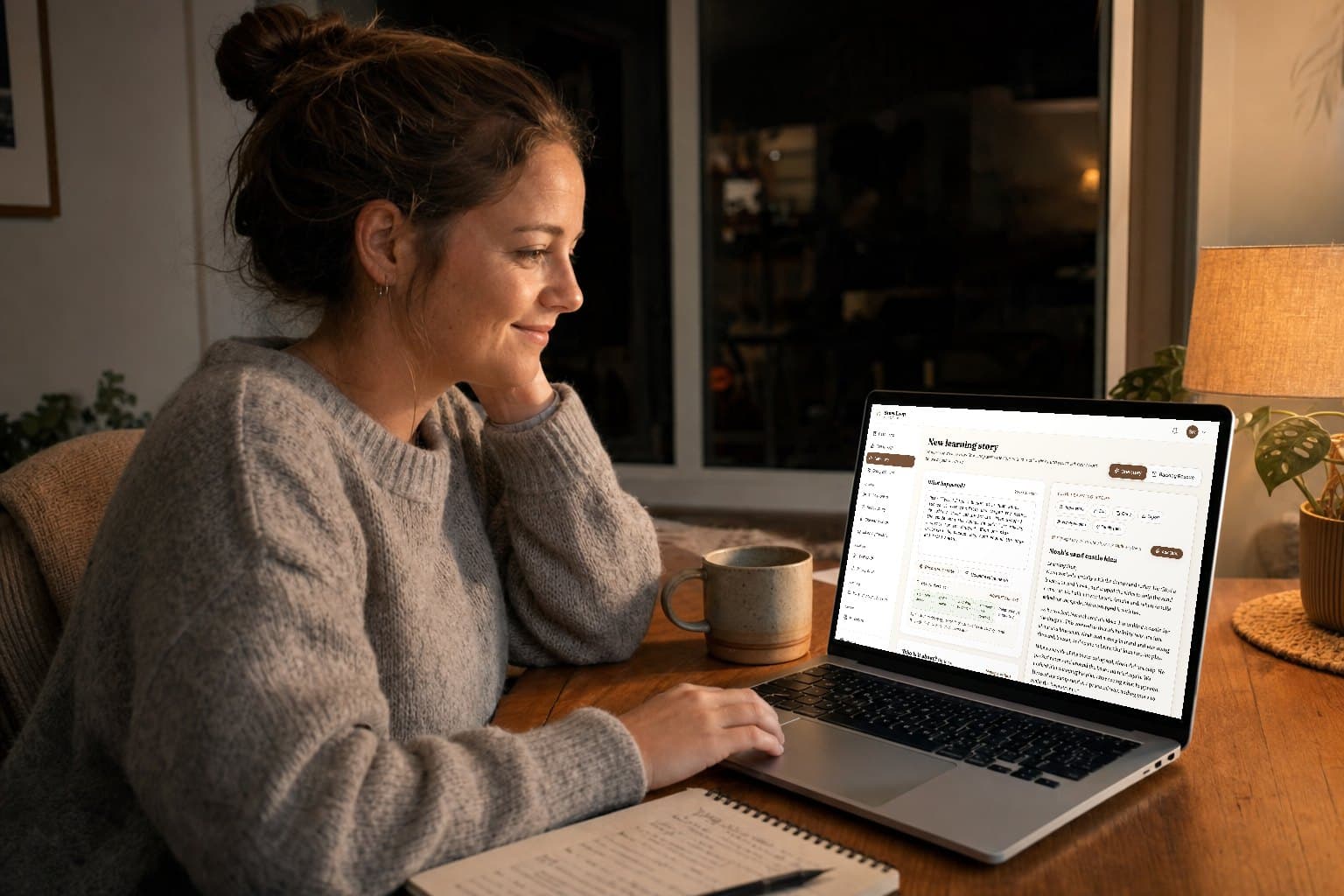
Learning story generator
StoryLoop helps educators move from rough notes to a clear first draft, while keeping educator reflection, final judgement, and family-ready editing at the centre.
Start with what actually happened: one action, quote, attempt, change, or question. A polished observation is never required.
StoryLoop drafts and checks. The educator reviews, edits, decides what is true, and chooses whether anything is shared.
What StoryLoop does with a note
A real note an educator typed, and the start of the draft StoryLoop wrote from it, unedited, with the Te Whāriki links, learning and next steps to follow.
Aroha tried to put her shoes on before going outside. Velcro kept folding over. Asked 'help me' then pushed my hand away and did the second one herself. Stood up and stomped both feet.
Putting on her own shoes
Before going outside, Aroha tried to put her shoes on by herself. The Velcro kept folding over, making the job trickier. Aroha asked, "help me", letting us know clearly that she needed support.
When help was offered, Aroha pushed the adult hand away and did the second shoe herself. Once both shoes were on, she stood up and stomped both feet. This looked like Aroha checking that her shoes were on and feeling the result with her whole body.
Type what you saw today. StoryLoop writes the draft here, with Te Whāriki or EYLF V2.0 links, and shows you exactly what it is built on. Use first names only: demo notes are not saved to any account and are never used to train AI.
No signup for your first try. Use a first name or initial only.
Your draft appears here, with curriculum links that only claim what your note shows, usually in under a minute.
Tip: what the child did, one thing they said, and what happened next. Three lines is plenty.
Want to keep it? Start free: 3 stories a month, no card. You check every word before anything is shared.
Each draft can include a title, observation, learning noticed, child voice, curriculum links, dispositions, responding ideas, and a family-friendly summary when needed.
The default writing avoids oversized words, generic praise, and overly poetic phrasing. You can choose natural, warm reflective, professional, or simple tone.
StoryLoop works on phone-friendly flows, so educators can capture moments close to when they happen instead of rebuilding the story at the end of the week.
You start with an observation. That can be a few rough words, a set of bullet points, or a voice note recorded while you were still on the floor with the child. The rougher the better in one sense, because the point is to capture the real detail in the moment, before the specifics blur into something generic by the evening.
StoryLoop reads what you wrote and produces a structured first draft: what happened, what learning was visible, the curriculum links with reasoning, a practical next step, and a question you could put to whānau. It keeps the child's own words exactly as you recorded them, and it does not add a child, a quote, a reaction, or a detail that your note did not contain.
You then review and edit everything. You add the context only you know, you change anything that is not quite right, and you decide what is true. Nothing is published or shared by StoryLoop. When you are happy, you copy or export it into whatever system your centre uses.
Most AI writing about children reads badly for two reasons. It gushes, reaching for words like beautiful and remarkable that the observation never earned, and it invents, filling gaps with plausible detail that never happened. Both are trust killers in documentation, because a family or an assessor can tell, and because a made up detail can lead to a real judgement about a child.
StoryLoop is built to avoid both. It uses plain educator language, it keeps every claim tied to evidence in your note, and it strips the tells that make writing feel machine made. Run the same observation twice and you get two genuinely different stories, because a folder of near identical documentation helps nobody.
The result is a draft that reads like a thoughtful educator wrote it for review, which is the whole point. You are meant to recognise your own room in it. If you cannot, the tool has failed, and that is the standard it is held to.
Try it on a real note from your week. StoryLoop writes the learning story, usually in under a minute, with the child's words kept exactly. No signup.
Try a noteFAQ
StoryLoop is an early childhood documentation tool that helps educators draft learning stories from real observations, voice notes, or bullet points.
Yes. Supported browsers can record microphone audio directly. If live recording is unavailable, educators can type bullet points or upload an audio file.
No. StoryLoop supports drafting and structure, while educators remain responsible for observation, interpretation, reflection, final editing, and sign-off.
Yes. Stories are editable after generation and saved in history, so educators can add context, adjust wording, copy, export, or regenerate from the original observation.
StoryLoop is designed to avoid generic, poetic AI wording. It asks for real observations, keeps claims evidence-based, and links curriculum only when the observation supports it.
The free plan includes 3 learning stories per month. Upgrade prompts are dismissible, and existing history remains available even if the free limit is reached.