Ireland · Aistear

Aistear learning stories that link to the Themes honestly.

The updated Aistear, published by the NCCA in December 2024 and in use from September 2025, kept its four Themes and cut back the learning goals. Learning stories are one of the most natural ways to show those Themes in a child's day, because they start from what the child actually did. This guide covers linking a story to Wellbeing, Identity and Belonging, Communicating, and Exploring and Thinking without turning it into a checklist.

Start with what actually happened: one action, quote, attempt, change, or question. A polished observation is never required.

StoryLoop drafts and checks. The educator reviews, edits, decides what is true, and chooses whether anything is shared.

Reviewed 13 October 2026 · Written by Leo, who builds StoryLoop, in Ōtautahi Christchurch

A one-page printable of Aistear's four Themes and the key changes in the 2024 update

Free printable

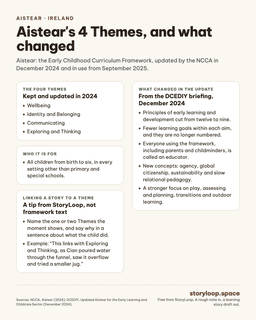
Aistear's 4 Themes and what changed, on one page

Download the PDFNo sign-up

What StoryLoop does with a note

A rough note in, an Aistear draft out.

A note we wrote to test it on 13 October 2026, not about a real child, and the draft StoryLoop wrote from it, unedited, with its Aistear links.

The note · Oisín, 2 years
Oisín 2y 4m outside after the rain. Stamped in the puddle, watched the splash, stamped harder. Said 'big splash!' Got a stick and drew lines in the mud, then showed me and said 'look, road'. Brought Ella over to stamp with him.
The draft, as StoryLoop wrote it

Puddles, mud and roads

Oisín was outside after the rain and went straight into investigating the puddle. He stamped in the water, watched the splash, and then stamped harder. When the splash changed, Oisín named what he saw: “big splash!”

He then picked up a stick and used it in the mud. Oisín drew lines and showed us his idea, saying “look, road”. He was not only making marks, he was giving those marks a meaning and sharing that meaning with us.

  • Aistear: Exploring and Thinking
  • Aistear: Communicating
  • Aistear: Identity and Belonging
Read the whole draft
Oisín was outside after the rain and went straight into investigating the puddle. He stamped in the water, watched the splash, and then stamped harder. When the splash changed, Oisín named what he saw: “big splash!” He then picked up a stick and used it in the mud. Oisín drew lines and showed us his idea, saying “look, road”. He was not only making marks, he was giving those marks a meaning and sharing that meaning with us. Oisín also brought Ella over to stamp with him. He wanted another child to join his play and shared the puddle experience with her. What learning we noticed Oisín was testing what his body could do in the puddle. He noticed that stamping made a splash, then changed his action by stamping harder. This showed early cause and effect thinking. His mud lines became a road in his play. Oisín used a simple natural material, a stick, to make marks and represent an idea. His words helped us understand what he was thinking. Bringing Ella over showed Oisín beginning to include others in his play. He used a shared experience, stamping in the puddle, as a way to connect with another child. Curriculum links Aistear: Exploring and Thinking. Oisín tested how the puddle responded when he stamped, changed the force of his stamping, and used a stick to draw lines in the mud. Aistear: Communicating. Oisín used words to name what happened and to explain his mark-making idea, including “big splash!” and “look, road”. Aistear: Identity and Belonging. Oisín invited Ella into the play, showing confidence in sharing an idea with another child. Where to next / Responding We can offer more outdoor mark-making after wet weather, with sticks, mud, water and open space for large movements. We can use simple language beside Oisín’s play, such as splash, bigger, line, road, long, short, soft and hard, while leaving room for his own words. We will continue to notice how Oisín shares his ideas with other children and how he changes his actions when he sees something new happen. Family link At home, Oisín might enjoy noticing puddles, tyre tracks, paths or marks in the mud during walks after rain.

Now try it with your own note. No signup.

Type what you saw today, the way a educator jots it down. StoryLoop writes the draft here with Aistear links, keeps the child's words exactly as you wrote them, and shows you what it is built on.

No signup for your first try. Use a first name or initial only.

Your draft appears here, with Aistear links that only claim what your note shows, usually in under a minute.

Tip: what the child did, one thing they said, and what happened next. Three lines is plenty.

Want to keep it? Start free: 3 stories a month, no card. Choose Aistear · Ireland when you write. You check every word before anything is shared.

What changed in the update

The four Themes were kept and updated. There are fewer learning goals within each aim, and they are no longer numbered. The principles went from twelve to nine, and everyone using the framework, including parents and childminders, is now called an educator.

Who it is for

Aistear covers all children from birth to six in every setting other than primary and special schools. The updated framework puts relationships at the heart of learning, with a stronger focus on play, assessing and planning, transitions and outdoor learning.

Where StoryLoop fits

Type a few rough lines about what a child did and said. StoryLoop drafts the learning story with links to the Aistear Themes the moment actually shows, keeps the child's words exactly as you wrote them, and you edit and decide what is shared with families.

What the December 2024 update changed

The Department of Children, Equality, Disability, Integration and Youth summarised the changes for the sector when the updated framework was published. The four Themes were retained and updated. The number of learning goals within each aim was reduced, and they remain broad, observable statements. The principles of early learning and development went from twelve to nine.

The update brings in new ideas including agency, global citizenship, sustainability and slow relational pedagogy, and gives a stronger focus to play, assessing and planning, transitions and outdoor learning. Irish words and phrases are used throughout the framework to connect children and families with the language and heritage of Ireland.

An example link for each Theme

These are written by us to show the shape, not about real children.

Wellbeing: 'Saoirse climbed to the top of the frame for the first time, looked down and called, "I did it!" This links with Wellbeing, as she took a safe risk and was proud of what her body could do.'

Identity and Belonging: 'Tomás showed the group the photo of his grandad's farm and told us the names of the cows. This links with Identity and Belonging, as he shared something important from home and the group listened.'

Communicating: 'Mia used the puppet to tell Ella the bear was sad because he lost his hat. This links with Communicating, as she used a story and a character to share an idea and a feeling.'

Exploring and Thinking: 'Cian poured water through the funnel, saw it overflow and tried a smaller jug. This links with Exploring and Thinking, as he tested an idea and changed what he did next.'
The learning goals are not a checklist

The updated learning goals are fewer, broad and no longer numbered. A learning story does not need to quote them. Name the Theme the moment shows and explain the link in what the child did and said, in a sentence a family can understand.

One or two Themes is usually right for one moment. The Themes are interconnected, so a strong story will often touch more than one, but listing all four for a single moment at the water tray tells nobody anything.

Irish words and family languages

If you use Irish words with the children, keep them in the story exactly as you would say them. If a child speaks another language at home and used it in the moment, write it down as they said it. StoryLoop keeps the words you wrote and does not add Irish words you did not use.

Using StoryLoop in Ireland

Choose Aistear · Ireland on the story page. StoryLoop writes in plain Irish and British English, links to the four Themes only where your note supports them, and flags anything it had to assume so you can check it. It mentions Síolta only if you do, and never uses Australian, New Zealand or English framework language in an Aistear draft.

The finished text copies into whatever your service already uses to share with families. StoryLoop does not connect directly to other apps, so it is a copy and paste.

Stories are stored in Sydney, Australia, and are never used to train AI models. If your service needs records kept in the EU, check with whoever handles data protection for you before using full names.

FAQ

Straight answers for educators.

What are the four Aistear Themes?+

Wellbeing; Identity and Belonging; Communicating; and Exploring and Thinking. Each Theme has aims and broad learning goals, which the updated framework describes as observable statements that support children's learning and development.

When did the updated Aistear come in?+

The NCCA published it in December 2024, the first update since 2009, and it came into use from September 2025. Printed copies went to settings through the City and County Childcare Committees in 2025.

Should I quote the learning goals in a learning story?+

There is no need. The updated learning goals are no longer numbered and are broad statements, not a checklist. Name the Theme the moment shows and explain the link in the child's own actions and words.

Can StoryLoop write Aistear learning stories?+

Yes. Choose Aistear · Ireland as the curriculum and StoryLoop links the draft to the four Themes in plain Irish and British English. It keeps any Irish words you wrote exactly as you wrote them and does not add ones you did not use. You check every word before it is shared.

Where is the data stored?+

StoryLoop stores stories in a database in Sydney, Australia, and never uses children's information to train AI models. Some providers that process a request are based in the United States. If your setting needs records kept in the UK or the EU, check with whoever handles data protection for you first, and use a first name or initials in the meantime.

How much does StoryLoop cost in euro?+

The free plan is 3 stories a month with no card. Paid plans are charged in New Zealand dollars (Educator is NZ$21 a month) and your bank converts the charge into euro on the day, so the exact amount moves a little with the exchange rate.

Does StoryLoop replace educator thinking?+

No. StoryLoop supports drafting and structure, while educators remain responsible for observation, interpretation, reflection, final editing, and sign-off.

Can I edit the generated stories?+

Yes. Stories are editable after generation and saved in history, so educators can add context, adjust wording, copy, export, or regenerate from the original observation.

Does it create generic AI stories?+

StoryLoop is designed to avoid generic, poetic AI wording. It asks for real observations, keeps claims evidence-based, and links curriculum only when the observation supports it.

How many stories are free?+

The free plan includes 3 learning stories per month. Upgrade prompts are dismissible, and existing history remains available even if the free limit is reached.