Outcome links with a reason
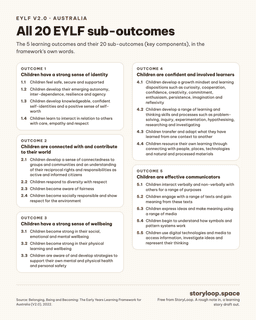
StoryLoop can link observations to EYLF outcomes such as confident and involved learners or effective communicators, with a short explanation of what evidence supports the link.
EYLF V2.0
StoryLoop supports EYLF-aligned story drafts that stay grounded in the observation, so educators can review, edit, and share with confidence.
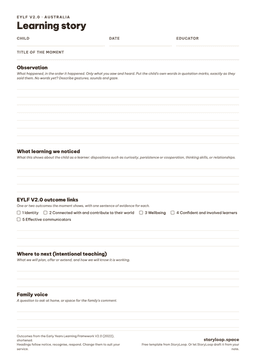
Start with what actually happened: one action, quote, attempt, change, or question. A polished observation is never required.
StoryLoop drafts and checks. The educator reviews, edits, decides what is true, and chooses whether anything is shared.
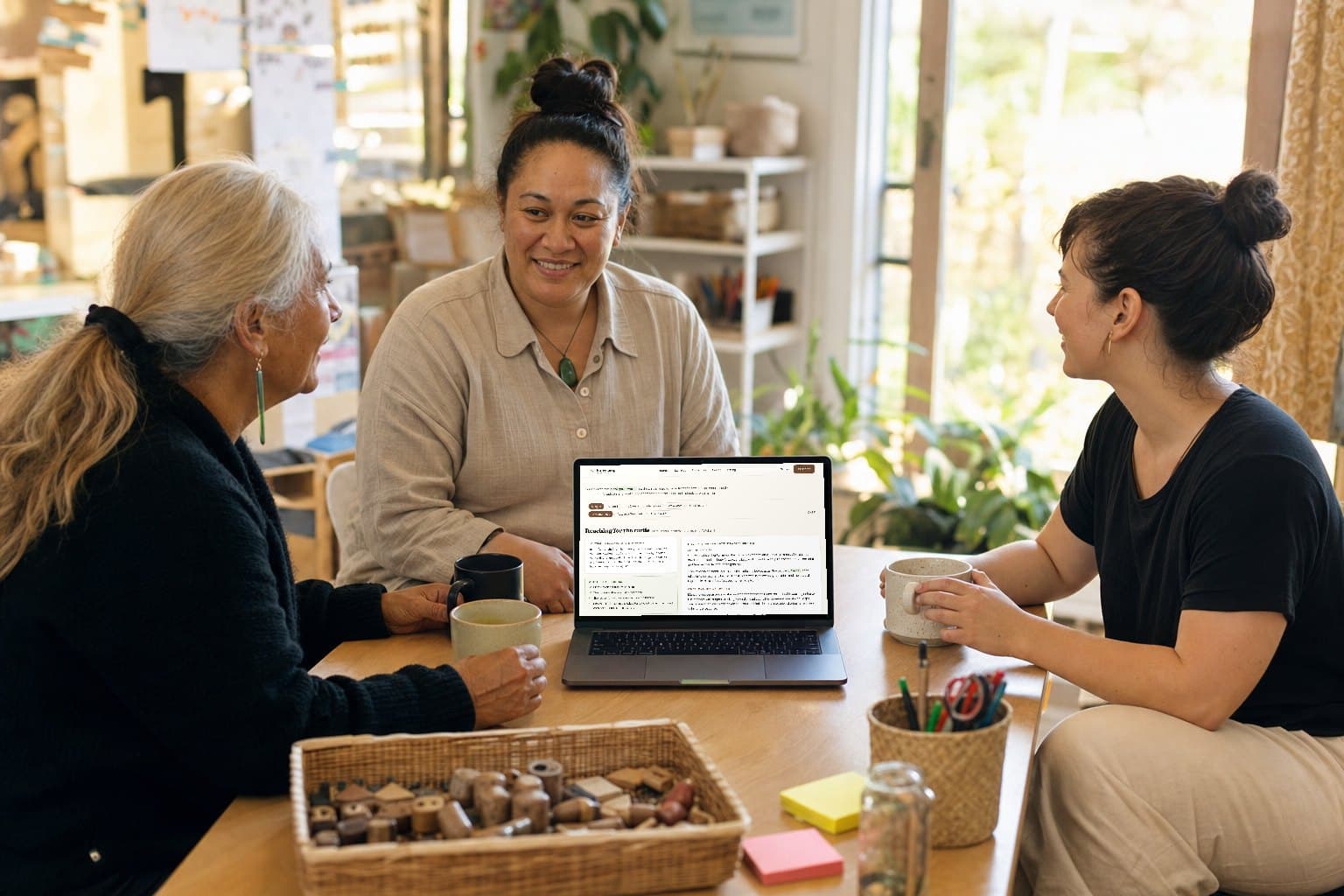
What StoryLoop does with a note
A real note an educator typed, and the start of the draft StoryLoop wrote from it, unedited, with the EYLF V2.0 links, learning and next steps to follow.
Jack sorted the bear counters by colour into the cups. Then lined up the red ones and counted 8. Put 2 blue ones on the end and said 'now it's ten'.
Sorting and making ten
Jack sorted the bear counters by colour into the cups. After sorting, he lined up the red bears and counted them. Jack counted 8 red bears, then added 2 blue bears to the end of the line and said, “now it's ten”.
What learning we noticed
Jack used sorting, counting and adding in one clear sequence. He noticed the colours, organised the bears into groups, counted the red bears, and then changed the set by adding two more. When Jack said, “now it's ten”, he showed that he was thinking about the total, not just naming the colours or counting by rote.
Type what you saw today. StoryLoop writes the draft here, with EYLF V2.0 links, and shows you exactly what it is built on. Use first names only: demo notes are not saved to any account and are never used to train AI.
No signup for your first try. Use a first name or initial only.
Your draft appears here, with EYLF V2.0 links that only claim what your note shows, usually in under a minute.
Tip: what the child did, one thing they said, and what happened next. Three lines is plenty.
Want to keep it? Start free: 3 stories a month, no card. You check every word before anything is shared.
StoryLoop can link observations to EYLF outcomes such as confident and involved learners or effective communicators, with a short explanation of what evidence supports the link.
The writing is warm and clear without unnecessary academic language, making it easier to edit for families, room leaders, and centre documentation.
Use it to get a first draft moving, then add your local context, child knowledge, and final professional judgement before publishing.
The Early Years Learning Framework frames documentation around five outcomes: a strong sense of identity, connection to and contribution to their world, a strong sense of wellbeing, confident and involved learning, and effective communication. A learning story is one of the most natural ways to evidence those outcomes, because it keeps the child and the real moment at the centre rather than reducing them to a checklist.
The EYLF leaves genuine room for narrative assessment. What it asks for is documentation that is meaningful, that connects to learning, and that informs planning. A story that notices something specific, interprets it honestly, and suggests a next step does all three. Length is not the measure. A tight three paragraphs that answer what happened, what it shows, and what comes next will always beat a page of description that never gets to the point.
Assessment and rating conversations tend to reward documentation that is clearly the educator's own thinking, responsive to the individual child, and linked to what happens next. That is worth remembering when it is tempting to write nine thin stories in a night. Fewer, better stories that you would happily explain to a parent are stronger evidence than volume.
In EYLF mode, StoryLoop writes for Australian educators and families. It uses EYLF outcome wording, avoids the Aotearoa specific framework language that belongs to Te Whāriki, and keeps the tone like a real educator wrote it rather than a policy document. You choose the depth and the tone, and the draft reflects them.
The draft stays anchored to your observation. It will link to Outcome 4 because a child was experimenting and adjusting, and it will say why, but it will not decide that a moment was about identity or wellbeing unless your note actually supports that. When the evidence is thin, it tells you honestly inside the story and asks you to confirm the rest, rather than padding it out with invented detail.
Everything you generate stays yours, editable and exportable into the format your service already uses, including Storypark, Educa, Kinderloop and Brightwheel friendly layouts. You are never locked in, and cancelling leaves all your work in place.
The part of documentation that most often gets dropped is the respond step. It is easy to notice and record, and much harder to close the loop by acting on what you noticed. A learning story that ends with a real, doable next step is the bridge between assessment and planning.
A next step should be something someone could actually do tomorrow. Continue to support the child's interest is a sentence, not a plan. Put the guttering out again on Thursday and see whether they predict what will happen before they change the angle is a plan, because it is specific and it can be acted on.
Over time, a run of honest stories about one child becomes a picture of how their learning is developing, which is exactly what a transition to school summary or a progress conversation with a family needs. That only works if the stories were grounded in the first place, which is why the discipline of not inventing detail matters so much.
Try it on a real note from your week. StoryLoop writes the learning story, usually in under a minute, with the child's words kept exactly. No signup.
Try a noteFAQ
Yes. It helps new educators see how observation, learning, curriculum, dispositions, and responding can fit together.
Yes. Experienced educators can use it as a fast first draft and still refine the interpretation themselves.
No. StoryLoop supports drafting and structure, while educators remain responsible for observation, interpretation, reflection, final editing, and sign-off.
Yes. Stories are editable after generation and saved in history, so educators can add context, adjust wording, copy, export, or regenerate from the original observation.
StoryLoop is designed to avoid generic, poetic AI wording. It asks for real observations, keeps claims evidence-based, and links curriculum only when the observation supports it.
The free plan includes 3 learning stories per month. Upgrade prompts are dismissible, and existing history remains available even if the free limit is reached.