EYLF V2.0 · Australia

The 8 EYLF principles and 7 practices, explained simply.

The Early Years Learning Framework V2.0 has eight principles and seven practices. The principles are what you believe about children and learning; the practices are what you do because of it; the five learning outcomes are what you are working towards. V2.0 added three principles and merged play-based learning and intentional teaching into one practice, which is why older lists show five principles and eight practices.

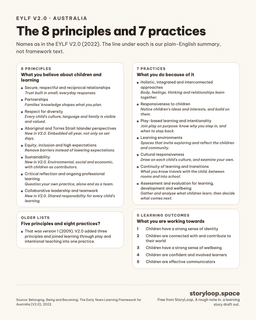
A one-page printable listing the 8 principles and 7 practices of EYLF V2.0, with a plain-English line under each

Free printable

The 8 EYLF principles and 7 practices, on one page

Download the PDFNo sign-up

Start with what actually happened: one action, quote, attempt, change, or question. A polished observation is never required.

StoryLoop drafts and checks. The educator reviews, edits, decides what is true, and chooses whether anything is shared.

Reviewed 29 September 2026 · Written by Leo, who builds StoryLoop, in Ōtautahi Christchurch

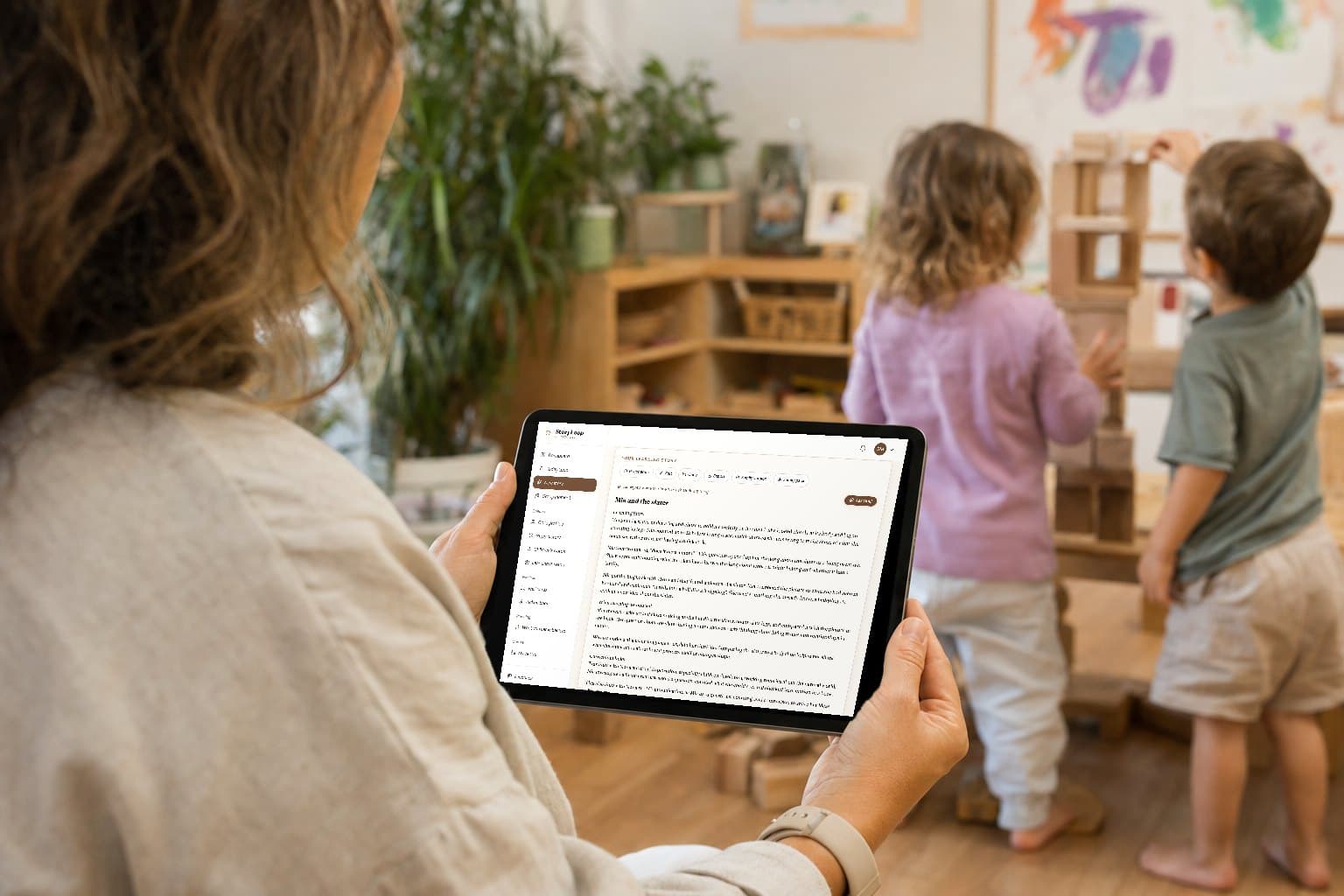
An educator in a centre holding a tablet with a learning story draft, children building with blocks behind her

What StoryLoop does with a note

A rough note in, a learning story out.

A real note an educator typed, and the start of the draft StoryLoop wrote from it, unedited, with the EYLF V2.0 links, learning and next steps to follow.

The note · Jack, 4 to 5 years
Jack sorted the bear counters by colour into the cups. Then lined up the red ones and counted 8. Put 2 blue ones on the end and said 'now it's ten'.
The draft, as StoryLoop wrote it

Sorting and making ten

Jack sorted the bear counters by colour into the cups. After sorting, he lined up the red bears and counted them. Jack counted 8 red bears, then added 2 blue bears to the end of the line and said, “now it's ten”.

What learning we noticed

Jack used sorting, counting and adding in one clear sequence. He noticed the colours, organised the bears into groups, counted the red bears, and then changed the set by adding two more. When Jack said, “now it's ten”, he showed that he was thinking about the total, not just naming the colours or counting by rote.

Read the full draft

Now try it with your own note. No signup.

Type what you saw today. StoryLoop writes the draft here, with EYLF V2.0 links, and shows you exactly what it is built on.

No signup for your first try. Use a first name or initial only.

Your draft appears here, with EYLF V2.0 links that only claim what your note shows, usually in under a minute.

Tip: what the child did, one thing they said, and what happened next. Three lines is plenty.

Want to keep it? Start free: 3 stories a month, no card. You check every word before anything is shared.

The eight principles

Secure, respectful and reciprocal relationships. Partnerships. Respect for diversity. Aboriginal and Torres Strait Islander perspectives. Equity, inclusion and high expectations. Sustainability. Critical reflection and ongoing professional learning. Collaborative leadership and teamwork.

The seven practices

Holistic, integrated and interconnected approaches. Responsiveness to children. Play-based learning and intentionality. Learning environments. Cultural responsiveness. Continuity of learning and transitions. Assessment and evaluation for learning, development and wellbeing.

What changed from version 1

Three principles are new: Aboriginal and Torres Strait Islander perspectives, sustainability, and collaborative leadership and teamwork. Learning through play and intentional teaching became one practice, and cultural competence became cultural responsiveness.

The principles, one at a time

Secure, respectful and reciprocal relationships: children learn best when they trust the adults around them, and that trust is built in small, everyday responses. Partnerships: families are children's first and most influential teachers, so their knowledge shapes what you plan. Respect for diversity: children's cultures, languages and family structures are visible and valued, not treated as extras.

Aboriginal and Torres Strait Islander perspectives: new in V2.0, it asks services to embed First Nations ways of knowing and being across the program, not only on particular days. Equity, inclusion and high expectations: every child can succeed, and educators remove barriers rather than lowering expectations. Sustainability: new in V2.0, covering environmental, social and economic sustainability, and children as active contributors to it.

Critical reflection and ongoing professional learning: educators question their own practice and keep learning, individually and as a team. Collaborative leadership and teamwork: new in V2.0, it describes shared responsibility for children's learning, with leadership that helps every member of the team do their best work.
The practices, and what they look like

Holistic, integrated and interconnected approaches: a child's body, feelings, thinking and relationships are learning together, so a block tower is also maths, language and friendship. Responsiveness to children: noticing a child's ideas and interests and building on them, in the moment and in your planning. Play-based learning and intentionality: play is the main context for learning, and educators take part in it deliberately, knowing why they step in and when to step back.

Learning environments: indoor and outdoor spaces that invite exploration and reflect the children and community. Cultural responsiveness: respecting and drawing on each child's culture, and examining your own. Continuity of learning and transitions: supporting children as they move between rooms, services and into school, with information that travels with them.

Assessment and evaluation for learning, development and wellbeing: gathering and analysing information about children's learning, and evaluating your own program, to decide what to do next. This is where learning stories, observations and planning cycles live.

Why older lists say eight practices

Version 1 of the EYLF, from 2009, had five principles and eight practices. Its practices included learning through play and intentional teaching as two separate items, and cultural competence and assessment for learning under older names. V2.0 joined the first two into play-based learning and intentionality and renamed the others, so it has seven practices. If a resource lists eight practices or five principles, it was written for version 1.

The five learning outcomes kept their names in V2.0, but several sub-outcomes were reworded, so it is worth checking outcome codes on older templates too.

FAQ

Straight answers for educators.

How many principles are in the EYLF V2.0?+

Eight: secure, respectful and reciprocal relationships; partnerships; respect for diversity; Aboriginal and Torres Strait Islander perspectives; equity, inclusion and high expectations; sustainability; critical reflection and ongoing professional learning; and collaborative leadership and teamwork.

How many practices are in the EYLF V2.0?+

Seven. Many lists still say eight because version 1 had eight: V2.0 combined learning through play and intentional teaching into one practice, play-based learning and intentionality.

What are the five EYLF learning outcomes?+

Children have a strong sense of identity; are connected with and contribute to their world; have a strong sense of wellbeing; are confident and involved learners; and are effective communicators. They did not change in V2.0, though several sub-outcomes were reworded.

Do I have to name a principle or practice in every observation?+

No. The principles and practices describe how you work, not labels for each record. ACECQA is clear there is no one way to document; what matters is that your records show children's learning and how your teaching responds to it.

Where do learning stories fit?+

Mostly in the practice of assessment and evaluation for learning, development and wellbeing: a story records what a child did, what you understood about their learning, and what you will do next. Written with families in mind, they also serve the partnerships principle.