Three new principles
Aboriginal and Torres Strait Islander perspectives, sustainability, and collaborative leadership and teamwork, taking the principles from five to eight. Two existing principles were also strengthened and renamed.
EYLF V2.0 · Australia
All Australian Education Ministers approved EYLF V2.0 in December 2022, and it was released in January 2023. From 1 February 2024 the original EYLF stopped being recognised under the National Law, so services are now assessed against V2.0. ACECQA describes it as an update and refresh, not a rewrite.
Start with what actually happened: one action, quote, attempt, change, or question. A polished observation is never required.
StoryLoop drafts and checks. The educator reviews, edits, decides what is true, and chooses whether anything is shared.
Reviewed 6 October 2026 · Written by Leo, who builds StoryLoop, in Ōtautahi Christchurch
What StoryLoop does with a note
A real note an educator typed, and the start of the draft StoryLoop wrote from it, unedited, with the EYLF V2.0 links, learning and next steps to follow.
Jack sorted the bear counters by colour into the cups. Then lined up the red ones and counted 8. Put 2 blue ones on the end and said 'now it's ten'.
Sorting and making ten
Jack sorted the bear counters by colour into the cups. After sorting, he lined up the red bears and counted them. Jack counted 8 red bears, then added 2 blue bears to the end of the line and said, “now it's ten”.
What learning we noticed
Jack used sorting, counting and adding in one clear sequence. He noticed the colours, organised the bears into groups, counted the red bears, and then changed the set by adding two more. When Jack said, “now it's ten”, he showed that he was thinking about the total, not just naming the colours or counting by rote.
Type what you saw today. StoryLoop writes the draft here, with EYLF V2.0 links, and shows you exactly what it is built on.
No signup for your first try. Use a first name or initial only.
Your draft appears here, with EYLF V2.0 links that only claim what your note shows, usually in under a minute.
Tip: what the child did, one thing they said, and what happened next. Three lines is plenty.
Want to keep it? Start free: 3 stories a month, no card. You check every word before anything is shared.
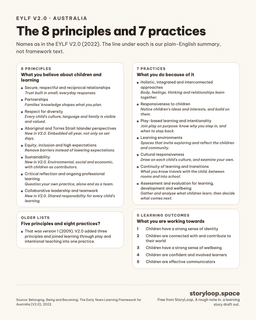
Aboriginal and Torres Strait Islander perspectives, sustainability, and collaborative leadership and teamwork, taking the principles from five to eight. Two existing principles were also strengthened and renamed.
Learning through play and intentional teaching became one practice, play-based learning and intentionality. Cultural competence became cultural responsiveness, and assessment for learning became assessment and evaluation for learning, development and wellbeing.
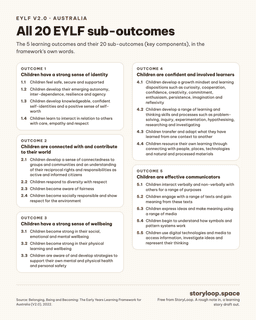
The five learning outcomes kept their names, but the sub-outcomes beneath them were revised. Outcome 3 now has three instead of two, and others were reworded, so older templates may use outdated codes.
Aboriginal and Torres Strait Islander perspectives are strengthened throughout the framework, in the vision, principles, practices and outcomes. ACECQA calls this one of the most significant shifts in V2.0.
Three principles are new: Aboriginal and Torres Strait Islander perspectives, sustainability, and collaborative leadership and teamwork. High expectations and equity became equity, inclusion and high expectations. Ongoing learning and reflective practice became critical reflection and ongoing professional learning. Secure, respectful and reciprocal relationships now includes relational pedagogy, and partnerships now include other professionals.
In the practices, the meaning of holistic approaches was clarified, play-based learning and intentionality became one practice, cultural competence was replaced with cultural responsiveness, and assessment was aligned with evaluation for learning, development and wellbeing. The link between the vision and the planning cycle was strengthened, and the guidance under each learning outcome was expanded.
December 2022: all Australian, state and territory Education Ministers approved EYLF V2.0 and My Time, Our Place V2.0. January 2023: both were released, and 2023 became a familiarisation year in which services could use either version.
1 February 2024: the original EYLF and MTOP stopped being recognised under the National Law. From then, services using the EYLF must use V2.0, and they are assessed and rated against it.
Check your templates. If a learning story or planning template lists five principles, eight practices or two sub-outcomes under outcome 3, it was written for version 1. Outcome 3 now runs 3.1 to 3.3, covering social, emotional and mental wellbeing, physical learning and wellbeing, and children's own strategies for health and personal safety.
Nothing about the update asks for more documentation. ACECQA's FAQ is clear that the National Quality Standard and the National Law did not change because of it. What changed is the language your links should use: outcome links worded the V2.0 way, and practice that shows the new principles, such as Aboriginal and Torres Strait Islander perspectives embedded across the program rather than kept for particular days.
The update ran from April 2021 to May 2022. A consortium led by Macquarie University, Queensland University of Technology and Edith Cowan University reviewed the research, heard from more than 5,400 educators, providers, families, children and other professionals, and piloted the changes in 16 services across Australia in early 2022 before the final version was written.
Official references
These sources inform this guide. StoryLoop is independent and does not claim endorsement.
FAQ
It was released in January 2023 and ran alongside the original EYLF through 2023. From 1 February 2024 the original stopped being recognised under the National Law, and services are assessed and rated against V2.0.
Aboriginal and Torres Strait Islander perspectives; sustainability; and collaborative leadership and teamwork. With the five existing principles, some renamed, there are eight.
The five outcomes kept their names. The sub-outcomes were revised: outcome 3 grew from two to three, 2.1 now speaks of children as active and informed citizens, 4.1 adds a growth mindset, and 5.5 refers to digital technologies and media.
No. ACECQA's FAQ says the National Quality Standard and the National Law were outside the update and did not change because of it. V2.0 does strengthen the links to the NQS in areas like transitions, sustainability and critical reflection.
The EYLF is a national framework. Victoria's own framework, the VEYLDF, was outside the update and remains an approved learning framework under the National Quality Framework.