England · EYFS 2026

EYFS observations worth writing, and quick to write.

The EYFS statutory framework is plain about it: ongoing assessment needs no written records and no physical evidence. Plenty of settings still write observations and learning stories anyway, because parents love reading them and key persons plan from them. This guide is about writing one that earns its place: linked to the seven areas only where the moment shows it, in your own words, and finished before you go home.

Start with what actually happened: one action, quote, attempt, change, or question. A polished observation is never required.

StoryLoop drafts and checks. The educator reviews, edits, decides what is true, and chooses whether anything is shared.

Reviewed 13 October 2026 · Written by Leo, who builds StoryLoop, in Ōtautahi Christchurch

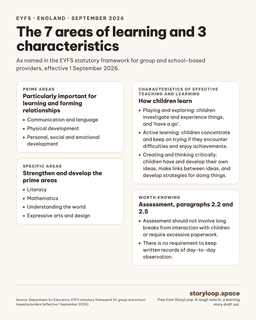
A one-page printable of the EYFS prime and specific areas of learning and the characteristics of effective teaching and learning

Free printable

The 7 EYFS areas and 3 characteristics, on one page

Download the PDFNo sign-up

What StoryLoop does with a note

A rough note in, an EYFS draft out.

A note we wrote to test it on 13 October 2026, not about a real child, and the draft StoryLoop wrote from it, unedited, with its EYFS links.

The note · Poppy, 3 years
Poppy (3y 2m) at the playdough table. Rolled long snakes and said 'mine is longest'. Lined hers up next to Alfie's to check. Then cut hers in half and said 'now it's two'. Counted the pieces 1, 2. Asked me for the knife to make more.
The draft, as StoryLoop wrote it

Making more with playdough

Poppy was at the playdough table rolling the dough into long snake shapes. As she looked at her own piece, she said, “mine is longest”. She then lined her playdough snake up next to Alfie’s to check.

After comparing the two pieces, Poppy changed her idea. She cut her long piece in half and said, “now it’s two”. She counted the pieces, “1, 2”, then asked us for the knife so she could make more.

  • EYFS: Mathematics
  • EYFS: Communication and language
  • EYFS characteristic: Creating and thinking critically
Read the whole draft
Poppy was at the playdough table rolling the dough into long snake shapes. As she looked at her own piece, she said, “mine is longest”. She then lined her playdough snake up next to Alfie’s to check. After comparing the two pieces, Poppy changed her idea. She cut her long piece in half and said, “now it’s two”. She counted the pieces, “1, 2”, then asked us for the knife so she could make more. What learning we noticed Poppy was using real mathematical thinking in her play. She compared length by placing her piece next to Alfie’s, rather than just guessing. When she cut the playdough in half, she noticed that one long piece had become two pieces, and she matched this with counting. Poppy also showed confidence in talking about her thinking. Her words helped us see what she was noticing: longest, two, and more. Asking for the knife showed that she had a plan and wanted to carry on changing the playdough herself. Curriculum links This links with EYFS: Mathematics, as Poppy compared length, noticed quantity, and counted two pieces. It also links with EYFS: Communication and language, as she used words to explain what she had made and what changed. We also saw Creating and thinking critically, as Poppy tested an idea, checked it against Alfie’s, then changed the playdough to make something new. Where to next / Responding We can keep playdough tools available so Poppy can cut, roll, compare and count in her own way. We can add simple measuring language as she plays, such as longer, shorter, same, more, less, one piece and two pieces. We can also offer chances to line up playdough shapes, ribbons or blocks so Poppy can keep comparing and checking her ideas. Family link At home, Poppy might enjoy comparing everyday objects by length, such as spoons, socks or toy cars, and counting what happens when something is shared or cut into pieces.

Now try it with your own note. No signup.

Type what you saw today, the way a practitioner jots it down. StoryLoop writes the draft here with EYFS links, keeps the child's words exactly as you wrote them, and shows you what it is built on.

No signup for your first try. Use a first name or initial only.

Your draft appears here, with EYFS links that only claim what your note shows, usually in under a minute.

Tip: what the child did, one thing they said, and what happened next. Three lines is plenty.

Want to keep it? Start free: 3 stories a month, no card. Choose EYFS · England when you write. You check every word before anything is shared.

What the framework requires

Paragraph 2.2 of the September 2026 framework says assessment should not involve long breaks from interaction with children or excessive paperwork, and that practitioners do not have to prove judgements with physical evidence. Paragraph 2.5 says there is no requirement to keep written records of day-to-day observation.

What it does still ask for

Keeping parents and carers up to date with their child's progress, a short written summary of development in the prime areas when a child is between two and three, and the EYFS profile at the end of reception. A good observation feeds the first two without extra work.

Where StoryLoop fits

Type a few rough lines about what a child did and said. StoryLoop drafts the observation with links to the EYFS areas and characteristics the moment actually shows, keeps the child's words exactly as you wrote them, and you edit and decide what is shared.

No written records required. So why write any?

Since the reforms, the EYFS has moved firmly away from evidence-gathering. The September 2026 framework says practitioners should draw on their knowledge of the child and their own professional judgement, and are not required to prove it with physical evidence. If an observation exists only so a folder looks full, stop writing it.

The observations worth keeping do a job. They tell a parent something real about their child's day. They help a key person notice a pattern and plan the next experience. They give you something to look back on when you write the progress check at two. A learning story, which tells one moment as a short narrative with what it shows and what comes next, does all three.

The seven areas and three characteristics, as the framework names them

Prime areas: communication and language; physical development; personal, social and emotional development. The framework calls these particularly important for learning and forming relationships.

Specific areas: literacy; mathematics; understanding the world; expressive arts and design. They strengthen and build on the prime areas.

Characteristics of effective teaching and learning: playing and exploring, where children investigate and have a go; active learning, where they concentrate and keep trying; and creating and thinking critically, where they have their own ideas, make links and develop strategies.

Writing the link in one honest sentence

A link should point at something the child did. Compare 'Links to Understanding the world' with 'This links with understanding the world, as Cooper tested how water moved through the funnel and changed his plan when it overflowed.' The second tells a parent what happened and tells a colleague why it matters.

Do the same for the characteristics. 'Shows creating and thinking critically' is a label. 'He tried a smaller jug when the first pour spilled, which is creating and thinking critically: he had an idea, tested it and changed his strategy' is an observation.

What a daily observation should not do

It should not make Early Learning Goal judgements. Those belong to the EYFS profile at the end of reception, made from what you know of the child across the year, not from one moment at the sand tray.

It should not score a child against Development Matters or Birth to 5 Matters statements. Both are non-statutory guidance. The framework says Development Matters can support a curriculum, and that inspectors do not take it into account.

Using StoryLoop in an English setting

Choose EYFS · England on the story page. StoryLoop writes in British English, links to the seven areas and the characteristics only where your note supports them, and flags anything it had to assume so you can check it. It will not use Australian or New Zealand framework language in an EYFS draft.

The finished text copies into whatever your setting already uses for learning journals. StoryLoop does not connect directly to Tapestry, Famly or any other app, so it is a copy and paste.

Stories are stored in Sydney, Australia, and are never used to train AI models. If your setting needs records kept in the UK, check with whoever handles data protection for you before using full names.

FAQ

Straight answers for educators.

Do I have to write observations under the EYFS?+

No. The EYFS statutory framework (effective 1 September 2026) says there is no requirement to keep written records of ongoing assessment, and practitioners do not have to prove their judgements with physical evidence. Many settings choose to write some, mostly to share with parents and carers and to plan.

What are the seven areas of learning in the EYFS?+

Three prime areas: communication and language; physical development; personal, social and emotional development. Four specific areas: literacy; mathematics; understanding the world; expressive arts and design.

What are the characteristics of effective teaching and learning?+

Playing and exploring (children investigate and have a go), active learning (they concentrate and keep trying when things are difficult), and creating and thinking critically (they have their own ideas, make links and develop strategies). They are about how a child learns, not what.

Is Development Matters statutory?+

No. The framework itself says Development Matters is non-statutory curriculum guidance, and that Ofsted and childminder agencies do not take it into account when they inspect. It is up to each provider how they deliver the learning and development requirements.

Can StoryLoop write EYFS observations?+

Yes. Choose EYFS · England as the curriculum and StoryLoop links the draft to the seven areas and the characteristics of effective teaching and learning, in British English. It does not make Early Learning Goal judgements or score a child against a checklist, and you check every word before it is shared.

Where is the data stored?+

StoryLoop stores stories in a database in Sydney, Australia, and never uses children's information to train AI models. Some providers that process a request are based in the United States. If your setting needs records kept in the UK or the EU, check with whoever handles data protection for you first, and use a first name or initials in the meantime.

How much does StoryLoop cost in pounds?+

The free plan is 3 stories a month with no card. Paid plans are charged in New Zealand dollars (Educator is NZ$21 a month) and your bank converts the charge into pounds on the day, so the exact amount moves a little with the exchange rate.

Does StoryLoop replace educator thinking?+

No. StoryLoop supports drafting and structure, while educators remain responsible for observation, interpretation, reflection, final editing, and sign-off.

Can I edit the generated stories?+

Yes. Stories are editable after generation and saved in history, so educators can add context, adjust wording, copy, export, or regenerate from the original observation.

Does it create generic AI stories?+

StoryLoop is designed to avoid generic, poetic AI wording. It asks for real observations, keeps claims evidence-based, and links curriculum only when the observation supports it.

How many stories are free?+

The free plan includes 3 learning stories per month. Upgrade prompts are dismissible, and existing history remains available even if the free limit is reached.