Strands are treated correctly
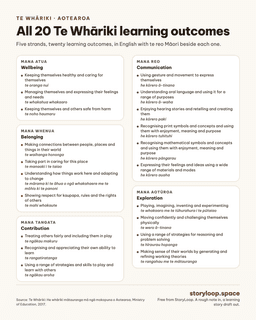
StoryLoop names strands such as Mana aotūroa | Exploration and then explains the related learning outcome idea, rather than treating Exploration or Communication as generic outcomes.
Te Whāriki
StoryLoop helps kaiako describe observed learning through Te Whāriki strands, outcome ideas, dispositions, working theories, and practical next steps.
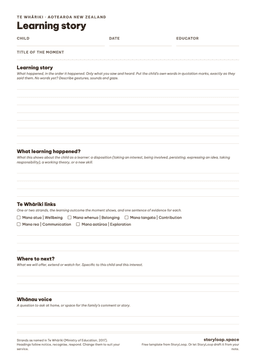
Start with what actually happened: one action, quote, attempt, change, or question. A polished observation is never required.
StoryLoop drafts and checks. The educator reviews, edits, decides what is true, and chooses whether anything is shared.

What StoryLoop does with a note
A real note an educator typed, and the start of the draft StoryLoop wrote from it, unedited, with the Te Whāriki links, learning and next steps to follow.
Aroha tried to put her shoes on before going outside. Velcro kept folding over. Asked 'help me' then pushed my hand away and did the second one herself. Stood up and stomped both feet.
Putting on her own shoes
Before going outside, Aroha tried to put her shoes on by herself. The Velcro kept folding over, making the job trickier. Aroha asked, "help me", letting us know clearly that she needed support.
When help was offered, Aroha pushed the adult hand away and did the second shoe herself. Once both shoes were on, she stood up and stomped both feet. This looked like Aroha checking that her shoes were on and feeling the result with her whole body.
Type what you saw today. StoryLoop writes the draft here, with Te Whāriki links, and shows you exactly what it is built on. Use first names only: demo notes are not saved to any account and are never used to train AI.
No signup for your first try. Use a first name or initial only.
Your draft appears here, with Te Whāriki links that only claim what your note shows, usually in under a minute.
Tip: what the child did, one thing they said, and what happened next. Three lines is plenty.
Want to keep it? Start free: 3 stories a month, no card. You check every word before anything is shared.
StoryLoop names strands such as Mana aotūroa | Exploration and then explains the related learning outcome idea, rather than treating Exploration or Communication as generic outcomes.
Curiosity, perseverance, inventiveness, collaboration, empathy, resilience, safe risk-taking, and problem solving are woven in when they are visible in the observation.
Next steps are written as usable teaching responses, such as adding resources, revisiting the interest, inviting child voice, or sharing a home connection with whānau.
A learning story is narrative assessment. It records a real moment, says what that moment shows about how a child is learning, and points to where the learning could go next. In a Te Whāriki setting it does that through the lens of the five strands: Mana atua, Mana whenua, Mana tangata, Mana reo and Mana aotūroa.
The mistake most of us make early on is treating the strands like boxes to tick. Te Whāriki is a woven mat, and the strands are threads that run through everything a child does, not separate compartments. A single moment at the water trough might carry exploration, communication and contribution all at once. Your job is to notice which threads are genuinely there, and to say why, rather than to force one link per story.
A good learning story is honest about its evidence. If you saw a child persist at something, say what they actually did that showed persistence. If you are interpreting rather than reporting, make that clear. Whānau can tell the difference between a story written by someone who was there and one written to hit a template, and so can an assessor.
StoryLoop takes the note you already made, whether that is a few typed words or a voice memo caught on the floor, and turns it into a first draft with the Te Whāriki links already suggested and the reasoning attached. You are not handed a finished story to rubber stamp. You are handed a starting point that is grounded in what you wrote, so your time goes into editing and adding your own knowledge of the child rather than facing a blank page.
It keeps a child's quoted words exactly as you recorded them, including the way a two year old actually said it, because that phrasing is the evidence and the part whānau treasure. It does not invent a quote you did not capture, and it does not add detail your note did not support. Anything it is unsure about is raised for you to confirm rather than written in as fact.
What it will never do is replace your judgement. The interpretation is yours to accept or change, the curriculum links are yours to confirm against your local curriculum, and nothing is shared with anyone unless you choose to share it. If a draft is wrong, it is wrong until you fix it. That is the correct order of authority, and it is built into how the product works.
The strongest curriculum links name the thinking, not the equipment. Weak: this links to Exploration because the child was playing with water. Strong: this links with Mana aotūroa, particularly using strategies for reasoning and problem solving, because the child changed one thing, watched what happened, and adjusted again.
Two well argued links are worth more than five vague ones. If the whole moment was really about turn taking and negotiation, say it links with Mana tangata and explain how, rather than reaching for Exploration because there happened to be blocks involved. Being specific is more honest and more useful to the next educator who reads it.
Working theories are the most misunderstood idea in the framework. A child repeating an action many times is usually not being repetitive, they are testing whether the world behaves the way they think it does. Naming that as an emerging working theory, when it is genuinely there, is exactly the kind of interpretation a rich learning story is for.
Try it on a real note from your week. StoryLoop writes the learning story, usually in under a minute, with the child's words kept exactly. No signup.
Try a noteFAQ
Yes, when enabled and relevant. It uses Kōwhiti as a notice, recognise, and respond lens rather than forcing it into every story.
StoryLoop uses te reo Māori carefully and in context, with low, medium, or high settings so educators can choose what suits their service.
No. StoryLoop supports drafting and structure, while educators remain responsible for observation, interpretation, reflection, final editing, and sign-off.
Yes. Stories are editable after generation and saved in history, so educators can add context, adjust wording, copy, export, or regenerate from the original observation.
StoryLoop is designed to avoid generic, poetic AI wording. It asks for real observations, keeps claims evidence-based, and links curriculum only when the observation supports it.
The free plan includes 3 learning stories per month. Upgrade prompts are dismissible, and existing history remains available even if the free limit is reached.