EYLF V2.0 · Australia
The 5 EYLF learning outcomes, in plain English
The Early Years Learning Framework (V2.0) sets five learning outcomes for children from birth to five:
- Children have a strong sense of identity, 4 sub-outcomes
- Children are connected with and contribute to their world, 4 sub-outcomes
- Children have a strong sense of wellbeing, 3 sub-outcomes
- Children are confident and involved learners, 4 sub-outcomes
- Children are effective communicators, 5 sub-outcomes
Each has sub-outcomes, 20 in all (the framework calls them key components), listed below in the framework's own words with what each can look like in play.
Updated 6 October 2026 · StoryLoop, Ōtautahi Christchurch
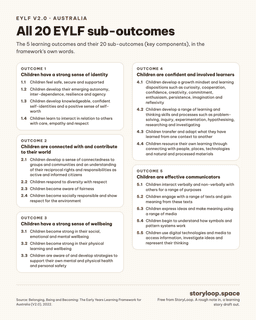
Quick list
All 20 EYLF sub-outcomes at a glance
Outcome 1: Identity
- 1.1Children feel safe, secure and supported
- 1.2Children develop their emerging autonomy, inter-dependence, resilience and agency
- 1.3Children develop knowledgeable, confident self-identities and a positive sense of self-worth
- 1.4Children learn to interact in relation to others with care, empathy and respect
Outcome 2: Community
- 2.1Children develop a sense of connectedness to groups and communities and an understanding of their reciprocal rights and responsibilities as active and informed citizens
- 2.2Children respond to diversity with respect
- 2.3Children become aware of fairness
- 2.4Children become socially responsible and show respect for the environment
Outcome 3: Wellbeing
- 3.1Children become strong in their social, emotional and mental wellbeing
- 3.2Children become strong in their physical learning and wellbeing
- 3.3Children are aware of and develop strategies to support their own mental and physical health and personal safety
Outcome 4: Learning
- 4.1Children develop a growth mindset and learning dispositions such as curiosity, cooperation, confidence, creativity, commitment, enthusiasm, persistence, imagination and reflexivity
- 4.2Children develop a range of learning and thinking skills and processes such as problem-solving, inquiry, experimentation, hypothesising, researching and investigating
- 4.3Children transfer and adapt what they have learned from one context to another
- 4.4Children resource their own learning through connecting with people, places, technologies and natural and processed materials
Outcome 5: Communication
- 5.1Children interact verbally and non-verbally with others for a range of purposes
- 5.2Children engage with a range of texts and gain meaning from these texts
- 5.3Children express ideas and make meaning using a range of media
- 5.4Children begin to understand how symbols and pattern systems work
- 5.5Children use digital technologies and media to access information, investigate ideas and represent their thinking
Each one is below with an everyday example of what it can look like in play.
What StoryLoop does with a note
A rough note in, a learning story out.
A real note an educator typed, and the start of the draft StoryLoop wrote from it, unedited, with the EYLF V2.0 links, learning and next steps to follow.
Jack sorted the bear counters by colour into the cups. Then lined up the red ones and counted 8. Put 2 blue ones on the end and said 'now it's ten'.
Sorting and making ten
Jack sorted the bear counters by colour into the cups. After sorting, he lined up the red bears and counted them. Jack counted 8 red bears, then added 2 blue bears to the end of the line and said, “now it's ten”.
What learning we noticed
Jack used sorting, counting and adding in one clear sequence. He noticed the colours, organised the bears into groups, counted the red bears, and then changed the set by adding two more. When Jack said, “now it's ten”, he showed that he was thinking about the total, not just naming the colours or counting by rote.
Now try it with your own note. No signup.
Type what you saw today. StoryLoop writes the draft here, with EYLF V2.0 links, and shows you exactly what it is built on.
No signup for your first try. Use a first name or initial only.
Your draft appears here, with EYLF V2.0 links that only claim what your note shows, usually in under a minute.
Tip: what the child did, one thing they said, and what happened next. Three lines is plenty.
Want to keep it? Start free: 3 stories a month, no card. You check every word before anything is shared.
Outcome 1
Children have a strong sense of identity
Children feel secure, know who they are, and are learning to get along with others.
| Sub-outcome | What it can look like |
|---|---|
| 1.1Children feel safe, secure and supportedLooks like: Settles with a familiar educator, asks for help or comfort, joins play with confidence. | Settles with a familiar educator, asks for help or comfort, joins play with confidence. |
| 1.2Children develop their emerging autonomy, inter-dependence, resilience and agencyLooks like: Puts on their own shoes, makes a choice and sticks with it, bounces back after a tumble. | Puts on their own shoes, makes a choice and sticks with it, bounces back after a tumble. |
| 1.3Children develop knowledgeable, confident self-identities and a positive sense of self-worthLooks like: Talks about their family or culture, shares a home language, is proud of what they made. | Talks about their family or culture, shares a home language, is proud of what they made. |
| 1.4Children learn to interact in relation to others with care, empathy and respectLooks like: Notices a friend is upset and brings their comforter, waits for a turn. | Notices a friend is upset and brings their comforter, waits for a turn. |
Outcome 1 in depth: examples for babies, toddlers and preschoolers
Outcome 2
Children are connected with and contribute to their world
Children belong to groups and communities, respect difference, notice fairness, and care for the environment.
| Sub-outcome | What it can look like |
|---|---|
| 2.1Children develop a sense of connectedness to groups and communities and an understanding of their reciprocal rights and responsibilities as active and informed citizensLooks like: Helps set up for morning tea, knows the group's routines, contributes to a group decision. | Helps set up for morning tea, knows the group's routines, contributes to a group decision. |
| 2.2Children respond to diversity with respectLooks like: Is curious about a friend's language or food, includes a child who plays differently. | Is curious about a friend's language or food, includes a child who plays differently. |
| 2.3Children become aware of fairnessLooks like: Says “that's not fair” and suggests a way to share, notices someone is left out. | Says “that's not fair” and suggests a way to share, notices someone is left out. |
| 2.4Children become socially responsible and show respect for the environmentLooks like: Waters the garden, puts a slater back under its log, sorts the compost. | Waters the garden, puts a slater back under its log, sorts the compost. |
Outcome 2 in depth: examples for babies, toddlers and preschoolers
Outcome 3
Children have a strong sense of wellbeing
Children are growing strong emotionally and physically, and learning to look after themselves.
| Sub-outcome | What it can look like |
|---|---|
| 3.1Children become strong in their social, emotional and mental wellbeingLooks like: Names a feeling, takes on a challenge, shares a joke, copes when a plan changes. | Names a feeling, takes on a challenge, shares a joke, copes when a plan changes. |
| 3.2Children become strong in their physical learning and wellbeingLooks like: Climbs to a new branch, practises balancing, uses scissors or a spoon with more control. | Climbs to a new branch, practises balancing, uses scissors or a spoon with more control. |
| 3.3Children are aware of and develop strategies to support their own mental and physical health and personal safetyLooks like: Washes hands before eating, asks for a rest, checks the ground before jumping. | Washes hands before eating, asks for a rest, checks the ground before jumping. |
Outcome 3 in depth: examples for babies, toddlers and preschoolers
Outcome 4
Children are confident and involved learners
Children are curious, try things out, stick with problems, and use what they learn somewhere new.
| Sub-outcome | What it can look like |
|---|---|
| 4.1Children develop a growth mindset and learning dispositions such as curiosity, cooperation, confidence, creativity, commitment, enthusiasm, persistence, imagination and reflexivityLooks like: Rebuilds a tower that fell, keeps going with a tricky puzzle, tries a new idea. | Rebuilds a tower that fell, keeps going with a tricky puzzle, tries a new idea. |
| 4.2Children develop a range of learning and thinking skills and processes such as problem-solving, inquiry, experimentation, hypothesising, researching and investigatingLooks like: Tests which ramp is fastest, asks “why?”, looks up a bug in a book. | Tests which ramp is fastest, asks “why?”, looks up a bug in a book. |
| 4.3Children transfer and adapt what they have learned from one context to anotherLooks like: Uses counting from mat time to share out the playdough. | Uses counting from mat time to share out the playdough. |
| 4.4Children resource their own learning through connecting with people, places, technologies and natural and processed materialsLooks like: Fetches the tape to fix their model, asks an older child how they did it. | Fetches the tape to fix their model, asks an older child how they did it. |
Outcome 4 in depth: examples for babies, toddlers and preschoolers
Outcome 5
Children are effective communicators
Children express themselves in words, gestures, marks, art and technology, and are beginning to read symbols.
| Sub-outcome | What it can look like |
|---|---|
| 5.1Children interact verbally and non-verbally with others for a range of purposesLooks like: Babbles back in a turn-taking “conversation”, points to ask, negotiates a role in play. | Babbles back in a turn-taking “conversation”, points to ask, negotiates a role in play. |
| 5.2Children engage with a range of texts and gain meaning from these textsLooks like: Joins in a repeated line of a picture book, retells a story. | Joins in a repeated line of a picture book, retells a story. |
| 5.3Children express ideas and make meaning using a range of mediaLooks like: Paints what happened at the beach, builds a “castle for the dragon”, dances a song. | Paints what happened at the beach, builds a “castle for the dragon”, dances a song. |
| 5.4Children begin to understand how symbols and pattern systems workLooks like: Writes the first letter of their name, makes a colour pattern, recognises a sign. | Writes the first letter of their name, makes a colour pattern, recognises a sign. |
| 5.5Children use digital technologies and media to access information, investigate ideas and represent their thinkingLooks like: Takes a photo of their block building, looks at a video to find out how a bird flies. | Takes a photo of their block building, looks at a video to find out how a bird flies. |
Outcome 5 in depth: examples for babies, toddlers and preschoolers
In a learning story
Linking a story to the outcomes honestly
A curriculum link is a claim: this moment shows this learning. It is only as strong as the evidence in the story. Name the outcome, then say in one sentence what the child did that shows it. For example, from a real StoryLoop draft:
EYLF Outcome 5: Children are effective communicators. Ruby used the words "all gone" to let us know she was finished, linking her words with what had just happened.
StoryLoop writes links this way for Australian services, using V2.0 wording, and never adds Te Whāriki to an Australian story. In the latest test, 48 of 48 drafts used the right framework for their country.
Questions educators ask
How many EYLF learning outcomes are there?
What changed in EYLF V2.0?
How many outcomes should a learning story link to?
Where do the EYLF outcomes fit in the planning cycle?
Is there an EYLF learning outcomes cheat sheet?
Drafts with EYLF V2.0 links, from your own notes
- Free forever: 3 stories a month, no card.
- Educator: unlimited stories, NZ$21 or A$19 a month, after a 7-day free trial.
- Educator Pro: NZ$33 or A$29 a month, with child profiles, family translation and unlimited Quill.
- Centres: one price for the team, from NZ$109 or A$99 a month for 10 educators.