EYLF V2.0 · Learning Outcome 4 of 5
Outcome 4: Children are confident and involved learners
Children are curious, try things out, stick with problems, and use what they learn somewhere new. The framework breaks it into 4 sub-outcomes:
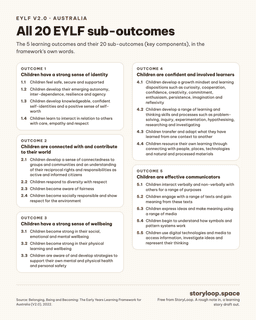
- 4.1 Children develop a growth mindset and learning dispositions such as curiosity, cooperation, confidence, creativity, commitment, enthusiasm, persistence, imagination and reflexivity
- 4.2 Children develop a range of learning and thinking skills and processes such as problem-solving, inquiry, experimentation, hypothesising, researching and investigating
- 4.3 Children transfer and adapt what they have learned from one context to another
- 4.4 Children resource their own learning through connecting with people, places, technologies and natural and processed materials
Updated 6 October 2026 · StoryLoop, Ōtautahi Christchurch
Outcome 4
Each sub-outcome, and what it can look like
The left column is the framework's own wording. The right column is StoryLoop's everyday example, not framework text.
| Sub-outcome | What it can look like |
|---|---|
| 4.1Children develop a growth mindset and learning dispositions such as curiosity, cooperation, confidence, creativity, commitment, enthusiasm, persistence, imagination and reflexivityLooks like: Rebuilds a tower that fell, keeps going with a tricky puzzle, tries a new idea. | Rebuilds a tower that fell, keeps going with a tricky puzzle, tries a new idea. |
| 4.2Children develop a range of learning and thinking skills and processes such as problem-solving, inquiry, experimentation, hypothesising, researching and investigatingLooks like: Tests which ramp is fastest, asks “why?”, looks up a bug in a book. | Tests which ramp is fastest, asks “why?”, looks up a bug in a book. |
| 4.3Children transfer and adapt what they have learned from one context to anotherLooks like: Uses counting from mat time to share out the playdough. | Uses counting from mat time to share out the playdough. |
| 4.4Children resource their own learning through connecting with people, places, technologies and natural and processed materialsLooks like: Fetches the tape to fix their model, asks an older child how they did it. | Fetches the tape to fix their model, asks an older child how they did it. |
By age
Outcome 4 with babies, toddlers and preschoolers
Babies. Repeats an action to make something happen again and explores objects with their hands and mouth.
Toddlers. Fills and tips containers again and again, and tries another way when a puzzle piece will not fit.
Preschoolers. Tests ideas about ramps or floating, sticks with a hard task, and uses an idea from one game in another.
These are StoryLoop's examples of what the learning can look like, not a checklist. Every child shows it in their own way and time.
From a real draft
How a real StoryLoop draft linked Outcome 4
The note:
zara at the easel mixing blue and yellow with her fingers. said green! when it changed. covered the whole page then did her hands. showed Mia her hands.
The curriculum link StoryLoop wrote in the draft, unedited:
EYLF Outcome 4: Children are confident and involved learners. Zara used her fingers to mix the paint, noticed the change, and kept adding paint across the page and onto her hands.
It names the outcome, then says in one sentence what the child did that shows it. Read the full draft.
What StoryLoop does with a note
A rough note in, a learning story out.
A real note an educator typed, and the start of the draft StoryLoop wrote from it, unedited, with the EYLF V2.0 links, learning and next steps to follow.
Jack sorted the bear counters by colour into the cups. Then lined up the red ones and counted 8. Put 2 blue ones on the end and said 'now it's ten'.
Sorting and making ten
Jack sorted the bear counters by colour into the cups. After sorting, he lined up the red bears and counted them. Jack counted 8 red bears, then added 2 blue bears to the end of the line and said, “now it's ten”.
What learning we noticed
Jack used sorting, counting and adding in one clear sequence. He noticed the colours, organised the bears into groups, counted the red bears, and then changed the set by adding two more. When Jack said, “now it's ten”, he showed that he was thinking about the total, not just naming the colours or counting by rote.
Now try it with your own note. No signup.
Type what you saw today. StoryLoop writes the draft here, with EYLF V2.0 links, and shows you exactly what it is built on.
No signup for your first try. Use a first name or initial only.
Your draft appears here, with EYLF V2.0 links that only claim what your note shows, usually in under a minute.
Tip: what the child did, one thing they said, and what happened next. Three lines is plenty.
Want to keep it? Start free: 3 stories a month, no card. You check every word before anything is shared.
Questions educators ask
What is EYLF Outcome 4?
What are the sub-outcomes of Outcome 4?
What are examples of EYLF Outcome 4?
How do I link a learning story to Outcome 4?
EYLF V2.0
The other four learning outcomes
Drafts that link Outcome 4 from your own notes
- Free forever: 3 stories a month, no card.
- Educator: unlimited stories, NZ$21 or A$19 a month, after a 7-day free trial.
- Educator Pro: NZ$33 or A$29 a month, with child profiles, family translation and unlimited Quill.
- Centres: one price for the team, from NZ$109 or A$99 a month for 10 educators.