Free template
Learning story template, free to copy
Two versions, one for Te Whāriki in Aotearoa New Zealand and one for the EYLF V2.0 in Australia. Each follows notice, recognise, respond: what happened, what learning it shows, and where to next, with a prompt under every heading. Copy it into Word, Google Docs, Canva or Storypark.
Updated 24 September 2026 · StoryLoop, Ōtautahi Christchurch
What StoryLoop does with a note
A rough note in, a learning story out.
A real note an educator typed, and the start of the draft StoryLoop wrote from it, unedited, with the Te Whāriki links, learning and next steps to follow.
Aroha tried to put her shoes on before going outside. Velcro kept folding over. Asked 'help me' then pushed my hand away and did the second one herself. Stood up and stomped both feet.
Putting on her own shoes
Before going outside, Aroha tried to put her shoes on by herself. The Velcro kept folding over, making the job trickier. Aroha asked, "help me", letting us know clearly that she needed support.
When help was offered, Aroha pushed the adult hand away and did the second shoe herself. Once both shoes were on, she stood up and stomped both feet. This looked like Aroha checking that her shoes were on and feeling the result with her whole body.
Now try it with your own note. No signup.
Type what you saw today. StoryLoop writes the draft here, with Te Whāriki or EYLF V2.0 links, and shows you exactly what it is built on.
No signup for your first try. Use a first name or initial only.
Your draft appears here, with curriculum links that only claim what your note shows, usually in under a minute.
Tip: what the child did, one thing they said, and what happened next. Three lines is plenty.
Want to keep it? Start free: 3 stories a month, no card. You check every word before anything is shared.
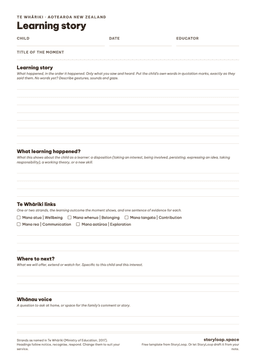
Aotearoa New Zealand
Te Whāriki learning story template
Te Whāriki template
[Title: a short name for the moment, e.g. "Mia and the slater"]

Learning story
[What happened, in the order it happened. Only what you saw and heard. Put the child's own words in quotation marks, exactly as they said them. If they had no words, describe their gestures, sounds and gaze.]

What learning happened?
[What this shows about the child as a learner: a disposition (taking an interest, being involved, persisting, expressing an idea, taking responsibility), a working theory, or a new skill. One or two short paragraphs.]

Te Whāriki links
[One or two strands, and the learning outcome the moment shows. Give one sentence of evidence for each, e.g.
Mana aotūroa | Exploration: Mia counted the slater's legs and checked a picture in the bug book.]

Where to next?
[What we will offer, extend or watch for. Make it specific to this child and this interest.]

Whānau voice
[A question to ask at home, or space for the family's comment or story.]
Need the strands and outcomes? See the Te Whāriki learning outcomes guide.
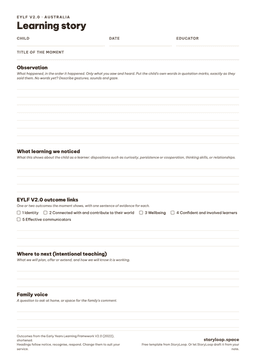
Australia
EYLF learning story template
EYLF V2.0 template
[Title: a short name for the moment, e.g. "Noah's sand castle idea"]

Observation
[What happened, in the order it happened. Only what you saw and heard. Put the child's own words in quotation marks, exactly as they said them. If they had no words, describe their gestures, sounds and gaze.]

What learning we noticed
[What this shows about the child as a learner: dispositions such as curiosity, persistence or cooperation, thinking skills, or relationships. One or two short paragraphs.]

EYLF V2.0 outcome links
[One or two outcomes the moment shows, with one sentence of evidence for each, e.g.
Outcome 4: Children are confident and involved learners. Noah packed more sand around the base and tried again.]

Where to next (intentional teaching)
[What we will plan, offer or extend, and how we will know it is working.]

Family voice
[A question to ask at home, or space for the family's comment.]
Every sub-outcome with an everyday example: the 5 EYLF learning outcomes.
Filling it in
Four things that make a template work
Write the child's words down at the time
A quote remembered hours later is rarely the quote. A two-word jotting beats a paragraph from memory.
Keep the story part to what you saw
Save “she felt proud” for the learning section, and say what showed you.
Link one or two outcomes, with evidence
One sentence of evidence per link is more convincing than five links with none.
Make “where to next” about this child
“Offer more collage” could be anyone. “Put the slater book in the reading corner for Mia” is a plan.
See a template filled in from a real note: the easel example, or 12 real drafts across every age.
Questions educators ask
Is this learning story template free?
Can I use it in Word, Google Docs or Canva?
Can I use it in Storypark or Educa?
How do I write a learning story for a baby or a child who does not talk yet?
Which headings are required?
Or skip the blank page: StoryLoop fills the template from your note
- Free forever: 3 stories a month, no card.
- Educator: unlimited stories, NZ$21 or A$19 a month, after a 7-day free trial.
- Educator Pro: NZ$33 or A$29 a month, with child profiles, family translation and unlimited Quill.
- Centres: one price for the team, from NZ$109 or A$99 a month for 10 educators.