Start from the note, not the area
Write down what the child did and said first. Decide which area it links to afterwards. Observations written to fill an area read like it, and parents notice.
England · EYFS examples
Four short examples, from a baby to a child about to start reception, each showing the rough note a practitioner might jot down, the observation written from it, the EYFS link and a next step. They are written by us to show the shape, not about real children. Yours should come from what you saw today.
Start with what actually happened: one action, quote, attempt, change, or question. A polished observation is never required.
StoryLoop drafts and checks. The educator reviews, edits, decides what is true, and chooses whether anything is shared.
Reviewed 13 October 2026 · Written by Leo, who builds StoryLoop, in Ōtautahi Christchurch
What StoryLoop does with a note
A note we wrote to test it on 13 October 2026, not about a real child, and the draft StoryLoop wrote from it, unedited, with its EYFS links.
Poppy (3y 2m) at the playdough table. Rolled long snakes and said 'mine is longest'. Lined hers up next to Alfie's to check. Then cut hers in half and said 'now it's two'. Counted the pieces 1, 2. Asked me for the knife to make more.
Making more with playdough
Poppy was at the playdough table rolling the dough into long snake shapes. As she looked at her own piece, she said, “mine is longest”. She then lined her playdough snake up next to Alfie’s to check.
After comparing the two pieces, Poppy changed her idea. She cut her long piece in half and said, “now it’s two”. She counted the pieces, “1, 2”, then asked us for the knife so she could make more.
Type what you saw today, the way a practitioner jots it down. StoryLoop writes the draft here with EYFS links, keeps the child's words exactly as you wrote them, and shows you what it is built on.
No signup for your first try. Use a first name or initial only.
Your draft appears here, with EYFS links that only claim what your note shows, usually in under a minute.
Tip: what the child did, one thing they said, and what happened next. Three lines is plenty.
Want to keep it? Start free: 3 stories a month, no card. Choose EYFS · England when you write. You check every word before anything is shared.
Write down what the child did and said first. Decide which area it links to afterwards. Observations written to fill an area read like it, and parents notice.
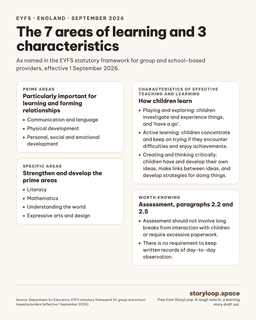
A strong observation names the one or two areas the moment clearly shows, and says why in a sentence. Ticking five areas for one moment at the water tray tells nobody anything.
The characteristics of effective teaching and learning are where an observation gets interesting: did the child keep trying, change their plan, have their own idea? That is the part a key person can plan from.
The note: 'Isla on tummy, ball rolled away, pushed up on arms, reached 3 times, rolled to side and got it. Big smile at me.'
The observation: Isla was on her tummy when the ball rolled just out of reach. She pushed up on her arms and reached for it three times, then rolled onto her side and stretched until she had it. She looked straight at me and smiled.
The link: physical development, as Isla used her arms and a roll to move her body towards something she wanted. It also shows active learning, because she kept trying after the first three reaches did not work.
Next step: place interesting objects just beyond reach during tummy time, and wait a moment longer before helping.
The note: 'Theo filling red bucket at sand, tipped out, said more sand! 4 times. Got Ava to hold the bucket.'
The observation: Theo filled the red bucket at the sand tray, tipped it out and said 'more sand!' He did this four times. On the last go he handed the bucket to Ava and showed her where to hold it while he filled it.
The link: communication and language, as Theo used a two-word phrase to say what he wanted next. It also links to personal, social and emotional development, because he invited Ava into his play and showed her what to do.
Next step: offer two buckets and a spade so Theo and a friend can take turns filling and tipping, and model words like 'full', 'empty' and 'your turn'.
The note: 'Amara block tower, fell over twice, made base wider, said it needs big feet. Counted 7 blocks tall.'
The observation: Amara's tower fell over twice. The third time she put more blocks at the bottom and said, 'It needs big feet.' It stood, and she counted the blocks, touching each one: seven.
The link: creating and thinking critically, as Amara had her own idea about why the tower fell and changed her strategy. Counting each block as she touched it links to mathematics.
Next step: add a few photos of real towers and bridges to the block area, and ask Amara what she thinks makes them stand up.
The note: 'Leo made a sign for the shop, wrote L and O, asked me how to write open. Told Sam the shop is closed for lunch.'
The observation: Leo made a sign for the role-play shop. He wrote an L and an O, then asked me how to write 'open'. Later he told Sam, 'The shop is closed for lunch,' and turned the sign over.
The link: literacy, as Leo used letters he knows and asked for help to write a word with a purpose. It also shows playing and exploring, because he used the sign to move his shop story along.
Next step: put clipboards, card and pens in the shop so Leo and his friends can write prices, lists and signs.
Each one starts from what the child did and said, keeps their words exactly, names one or two areas, and says why in the child's own actions. None of them makes a judgement about whether the child is on track. That is a decision for you, from everything you know about them.
Official references
These sources inform this guide. StoryLoop is independent and does not claim endorsement.
FAQ
As long as it needs to be to show the learning, which is often three to six sentences. The framework sets no length and no number of observations. Quality and usefulness matter more than quantity.
Yes, whenever you have them. A child's own words are the strongest evidence of communication and language and of their thinking, and parents treasure them. Write them exactly as the child said them, not tidied up.
You can, if the moment really shows each one. Most moments show one or two clearly. Name those and explain the link in the child's actions, rather than listing every area the activity could touch.
Yes. Type the rough note, choose EYFS · England, and StoryLoop drafts the observation with the area and characteristic links and a next step. Try it on this page without signing up.
StoryLoop stores stories in a database in Sydney, Australia, and never uses children's information to train AI models. Some providers that process a request are based in the United States. If your setting needs records kept in the UK or the EU, check with whoever handles data protection for you first, and use a first name or initials in the meantime.
The free plan is 3 stories a month with no card. Paid plans are charged in New Zealand dollars (Educator is NZ$21 a month) and your bank converts the charge into pounds on the day, so the exact amount moves a little with the exchange rate.
No. StoryLoop supports drafting and structure, while educators remain responsible for observation, interpretation, reflection, final editing, and sign-off.
Yes. Stories are editable after generation and saved in history, so educators can add context, adjust wording, copy, export, or regenerate from the original observation.
StoryLoop is designed to avoid generic, poetic AI wording. It asks for real observations, keeps claims evidence-based, and links curriculum only when the observation supports it.
The free plan includes 3 learning stories per month. Upgrade prompts are dismissible, and existing history remains available even if the free limit is reached.