Te Whāriki · Aotearoa

The Te Whāriki PDF, and where everything is in it.

Te Whāriki: He whāriki mātauranga mō ngā mokopuna o Aotearoa Early childhood curriculum was published by the Ministry of Education in 2017. The official PDF is free on Te Whāriki Online. Below is what is on which page, so you can go straight to the strands, goals and learning outcomes.

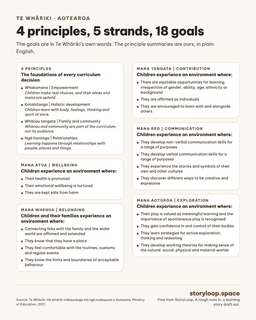
A one-page printable of the four Te Whāriki principles and the goals of each of the five strands

Free printable

Te Whāriki's 4 principles, 5 strands and 18 goals, on one page

Download the PDFNo sign-up
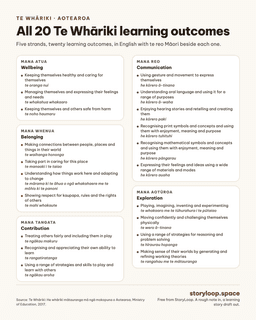
A one-page printable listing the 20 Te Whāriki learning outcomes by strand, in English and te reo Māori

Free printable

All 20 Te Whāriki learning outcomes, on one page

Download the PDFNo sign-up

Start with what actually happened: one action, quote, attempt, change, or question. A polished observation is never required.

StoryLoop drafts and checks. The educator reviews, edits, decides what is true, and chooses whether anything is shared.

Reviewed 6 October 2026 · Written by Leo, who builds StoryLoop, in Ōtautahi Christchurch

What StoryLoop does with a note

A rough note in, a learning story out.

A real note an educator typed, and the start of the draft StoryLoop wrote from it, unedited, with the Te Whāriki links, learning and next steps to follow.

The note · Aroha, 2 to 3 years
Aroha tried to put her shoes on before going outside. Velcro kept folding over. Asked 'help me' then pushed my hand away and did the second one herself. Stood up and stomped both feet.
The draft, as StoryLoop wrote it

Putting on her own shoes

Before going outside, Aroha tried to put her shoes on by herself. The Velcro kept folding over, making the job trickier. Aroha asked, "help me", letting us know clearly that she needed support.

When help was offered, Aroha pushed the adult hand away and did the second shoe herself. Once both shoes were on, she stood up and stomped both feet. This looked like Aroha checking that her shoes were on and feeling the result with her whole body.

Read the full draft

Now try it with your own note. No signup.

Type what you saw today. StoryLoop writes the draft here, with Te Whāriki links, and shows you exactly what it is built on.

No signup for your first try. Use a first name or initial only.

Your draft appears here, with Te Whāriki links that only claim what your note shows, usually in under a minute.

Tip: what the child did, one thing they said, and what happened next. Three lines is plenty.

Want to keep it? Start free: 3 stories a month, no card. You check every word before anything is shared.

Where to download it

Te Whāriki Online (tewhariki.tahurangi.education.govt.nz), the Ministry of Education's site, has the curriculum document page with the PDF. Download it from there rather than from a copy on another site, so you know you have the current version.

The pages most kaiako need

The principles are on pages 17 to 21. Strands, goals and learning outcomes start on page 22, with all five strands side by side on pages 24 and 25. Assessment, planning and evaluation is on page 63.

Two pathways, one framework

The printed curriculum is a flip book. One side is Te Whāriki for all early childhood services; the other is Te Whāriki a te Kōhanga Reo, for kōhanga reo affiliated to Te Kōhanga Reo National Trust. Neither is a translation of the other.

What is on which page

Foreword, page 2. Te Tiriti o Waitangi | The Treaty of Waitangi, page 3. Introduction, page 6. Early childhood education in New Zealand, page 8. The whāriki, page 10. A curriculum for all children, page 12. How the curriculum framework is organised, page 16.

Principles | Kaupapa whakahaere, page 17: Empowerment | Whakamana 18, Holistic development | Kotahitanga 19, Family and community | Whānau tangata 20, Relationships | Ngā hononga 21.

Strands, goals and learning outcomes | Taumata whakahirahira, page 22, with the overview of all five strands on page 24. Wellbeing | Mana atua 26, Belonging | Mana whenua 30, Contribution | Mana tangata 36, Communication | Mana reo 41, Exploration | Mana aotūroa 46.

Pathways to school and kura, page 51. Responsibilities of kaiako, page 59. Underpinning theories and approaches, page 60. Assessment, planning and evaluation, page 63. Glossary of Māori and Pasifika words, page 66. References, page 68. Te Whāriki: Two pathways, page 69.

These are the numbers printed on the pages. In the English web PDF your reader's page counter runs two ahead, so printed page 24 is page 26 of the file.
What the 2017 update changed

Te Whāriki was first published in 1996. The 2017 update left the principles and strands untouched and kept the whāriki, the woven mat, as its central metaphor. It gave clear learning outcomes, 20 across the five strands, made explicit links to The New Zealand Curriculum and Te Marautanga o Aotearoa, and placed more emphasis on language, culture and identity.

Each strand has dual English and Māori names. The document notes that while closely related, different cultural connotations mean the two are not equivalents, which is why a learning story names both: Mana aotūroa | Exploration, not one or the other.

Using it when you write learning stories

Most kaiako only need pages 24 and 25 open while they write: the five strands, their goals and the 20 learning outcomes in one view. The goals describe what kaiako provide; the learning outcomes describe what children become increasingly capable of. A story links to a strand, and to an outcome where one fits closely, and says in a sentence what the child did that shows it.

StoryLoop has a page for each strand with its goals and learning outcomes in the curriculum's own words, and a page listing all 20 outcomes, so you can check a link without opening the PDF.

Official references

These sources inform this guide. StoryLoop is independent and does not claim endorsement.

FAQ

Straight answers for educators.

Where can I download the Te Whāriki PDF?+

From Te Whāriki Online, the Ministry of Education's site for the curriculum, on the page for the Te Whāriki early childhood curriculum document. It is free.

What page are the Te Whāriki learning outcomes on?+

All five strands, with their goals and 20 learning outcomes, are side by side on pages 24 and 25. Each strand then has its own section: Wellbeing from page 26, Belonging 30, Contribution 36, Communication 41 and Exploration 46.

How many pages is Te Whāriki?+

The English web PDF is 72 pages including the covers. The printed page numbers run to 69, so your PDF reader's page counter runs two ahead: printed page 24 is page 26 of the file.

When was Te Whāriki last updated?+

It was first published in 1996 and updated in 2017. The update left the principles and strands untouched and added clearer learning outcomes, 20 in all.

Is there a te reo Māori version?+

The other side of the flip book is Te Whāriki a te Kōhanga Reo, a distinct curriculum pathway for kōhanga reo. The document is clear that neither part is a translation of the other.