One moment, not the whole week
A learning story tells one thing a child did, in the order it happened, with their own words kept exactly. A list of everything from the week is a summary, and it is much harder to link honestly.
Educator guide · EYLF V2.0
Six short examples, from a baby to a child about to start school. Each one shows the note an educator might jot down in the moment, the learning story written from it, the EYLF V2.0 outcome it shows, and what you might plan next. The children are imagined, to show the shape. Yours should come from what you noticed today.
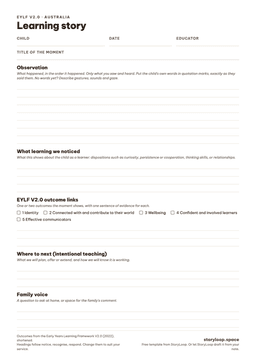
Start with what actually happened: one action, quote, attempt, change, or question. A polished observation is never required.
StoryLoop drafts and checks. The educator reviews, edits, decides what is true, and chooses whether anything is shared.
Reviewed 10 November 2026 · Written by Leo, who builds StoryLoop, in Ōtautahi Christchurch
What StoryLoop does with a note
A real note an educator typed, and the start of the draft StoryLoop wrote from it, unedited, with the Te Whāriki links, learning and next steps to follow.
Aroha tried to put her shoes on before going outside. Velcro kept folding over. Asked 'help me' then pushed my hand away and did the second one herself. Stood up and stomped both feet.
Putting on her own shoes
Before going outside, Aroha tried to put her shoes on by herself. The Velcro kept folding over, making the job trickier. Aroha asked, "help me", letting us know clearly that she needed support.
When help was offered, Aroha pushed the adult hand away and did the second shoe herself. Once both shoes were on, she stood up and stomped both feet. This looked like Aroha checking that her shoes were on and feeling the result with her whole body.
Type what you saw today. StoryLoop writes the draft here, with Te Whāriki or EYLF V2.0 links, and shows you exactly what it is built on. Use first names only: demo notes are not saved to any account and are never used to train AI.
No signup for your first try. Use a first name or initial only.
Your draft appears here, with curriculum links that only claim what your note shows, usually in under a minute.
Tip: what the child did, one thing they said, and what happened next. Three lines is plenty.
Want to keep it? Start free: 3 stories a month, no card. You check every word before anything is shared.
A learning story tells one thing a child did, in the order it happened, with their own words kept exactly. A list of everything from the week is a summary, and it is much harder to link honestly.
"Outcome 4" on its own tells a family nothing. Name the outcome, and the key component when one fits closely, then say in one sentence what the child did that shows it.
Where to next is what you will offer or change because of what you saw. One question for the family turns the story into a conversation, and their answer becomes part of the picture.
The note is what an educator might scribble on a sticky note or say into their phone in the moment. The story is what it becomes, in full sentences a family can read. Then comes the learning: the EYLF V2.0 outcome and key component in the framework's own words, and a sentence on why the moment fits. Last is where to next, with one question for the family.
That is the assessment and planning cycle on one page: you observed, you worked out what it shows, and you planned a response. Nothing more is needed for a story to be useful.
The note: "Morning tea. Isla pointed at the banana, looked at me, said 'ba'. I said 'banana?' and she bounced and clapped. Gave her a piece. Pointed at her cup next, 'ba' again."
The story: At morning tea Isla pointed at the banana, looked up at her educator and said, "ba". When the educator answered, "Banana?", Isla bounced in her seat and clapped. She ate her piece, then pointed at her cup and said "ba" again, watching to see what would happen.
The learning: EYLF Outcome 5: Children are effective communicators, "Children interact verbally and non-verbally with others for a range of purposes" (5.1). Isla used pointing, eye contact and a sound together to ask for what she wanted, then waited for an answer. She is learning that communication goes both ways.
Where to next: name what Isla points to and pause so she can take a turn, and offer two choices at meals so she has a reason to ask. For the family: what does Isla point to or ask for at home, and what sounds does she use?
The note: "Water trough. Arjun poured the jug into the funnel over and over, watched it run out the bottom, put his hand under to catch it. Said 'gone'. Then tried the cup, looked underneath it."
The story: Arjun spent a long time at the water trough today. He poured water from the jug into the funnel again and again, watching it run out the bottom, then held his hand underneath to catch it. "Gone," he said, when the jug was empty. Next he poured into a cup and bent down to look underneath, checking whether the water would come out there too.
The learning: EYLF Outcome 4: Children are confident and involved learners, "Children develop a range of learning and thinking skills and processes such as problem-solving, inquiry, experimentation, hypothesising, researching and investigating" (4.2). Arjun repeated an action to see whether the result stayed the same, then tested his idea on a different container. That is experimenting.
Where to next: add a sieve, a tube and a bottle with a hole to the trough, and use the words full, empty, through and under while he plays. For the family: does Arjun like pouring and tipping in the bath or at the sink?
The note: "Lunch. Mia served her own rice with the big spoon, some went on the table. 'Uh oh.' Got the cloth from the shelf by herself and wiped it. 'I did it.'"
The story: At lunch Mia served her own rice with the big serving spoon. Some landed on the table. "Uh oh," she said, then climbed down, took the cloth from the shelf and wiped the table herself. She looked up and said, "I did it."
The learning: EYLF Outcome 1: Children have a strong sense of identity, "Children develop their emerging autonomy, inter-dependence, resilience and agency" (1.2). Mia chose to serve herself, dealt with a spill without waiting for help and was proud of it. She knows where things are kept and that she is trusted to use them.
Where to next: keep the cloths and a small jug where Mia can reach them, and invite her to help set the table. For the family: what does Mia like to do by herself at home?
The note: "After rain, snail on the path. Noah: 'Don't step on him!' Put three sticks around it, told Ava and Sam to walk around. Carried it to the garden bed on a leaf. 'He lives here.'"
The story: After the rain Noah found a snail in the middle of the path. "Don't step on him!" he called. He laid three sticks around the snail and told Ava and Sam to walk around. Then he slid a leaf under the snail, carried it to the garden bed and set it down. "He lives here," he said.
The learning: EYLF Outcome 2: Children are connected with and contribute to their world, "Children become socially responsible and show respect for the environment" (2.4). Noah noticed a living thing at risk, made a plan to protect it and asked his friends to help. He showed care for the natural world and for how his group shares the space.
Where to next: look for snails and other small creatures in the garden with Noah after the next rain, and ask the group what else in our yard needs looking after. For the family: does Noah notice insects and animals when you are out together?
The note: "Obstacle course. Chloe stopped at the beam: 'I can't.' Watched Eli go across. Asked to hold one of my fingers. Third go she let go for the last two steps and jumped off. 'I did the whole thing!'"
The story: Chloe stopped when she reached the balance beam on the obstacle course. "I can't," she said. She watched Eli walk across, then asked to hold one of her educator's fingers and tried it. On her third go she let go for the last two steps and jumped off the end. "I did the whole thing!"
The learning: EYLF Outcome 3: Children have a strong sense of wellbeing, "Children become strong in their physical learning and wellbeing" (3.2). Chloe worked on her balance and judged for herself how much help she needed, a little less each time. Coming back for a third try also shows persistence, which is why this story adds a second link: EYLF Outcome 4: Children are confident and involved learners, "Children develop a growth mindset and learning dispositions such as curiosity, cooperation, confidence, creativity, commitment, enthusiasm, persistence, imagination and reflexivity" (4.1).
Where to next: leave the beam out this week and add a lower plank beside it, so Chloe can choose her own challenge. For the family: what is Chloe proud of being able to do with her body at the moment?
The note: "Home corner. Ethan wrote a shopping list: M for milk, drew four eggs and counted '1, 2, 3, 4', wrote a 4 next to them. Read it to Ava: 'Milk and four eggs.'"
The story: Ethan decided the home corner needed a shopping list. He wrote an M for milk, drew four eggs, counted them, "1, 2, 3, 4", and wrote a 4 beside them. Then he held the list up and read it to Ava: "Milk and four eggs."
The learning: EYLF Outcome 5: Children are effective communicators, "Children begin to understand how symbols and pattern systems work" (5.4). Ethan used a letter, a drawing and a numeral to carry meaning, and read them back to a friend. He understands that marks on paper can stand for words and amounts.
Where to next: add notepads, pencils and shop catalogues to the home corner, and write a real shopping list with Ethan before the next cooking experience. For the family: does Ethan like to help write lists or notes at home?
Each one is a single moment, not a summary of the week. The child's own words are kept exactly as they were said. The outcome is named in full and explained by what the child did, so a family, a colleague or an assessor can see why it fits. And each ends with something an educator will actually do, plus one question a family can answer.
None of them claims more than two outcomes. A story that links all five says less, not more.
The note is the part only you can write. Type it into the box on this page and StoryLoop drafts the learning story with the EYLF V2.0 outcomes the moment shows, where to next and a family link, keeping the child's words exactly as you wrote them. Use a first name only, and check every word before anything is shared.
Try it on a real note from your week. StoryLoop writes the learning story, usually in under a minute, with the child's words kept exactly. No signup.
Try a noteOfficial references
These sources inform this guide. StoryLoop is independent and does not claim endorsement.
FAQ
It tells one real moment in plain words a family will enjoy reading: what the child did and said, what learning it shows with one or two EYLF V2.0 outcomes, and what you will do next. Keep the child's own words exactly as they said them, and leave out anything you did not see.
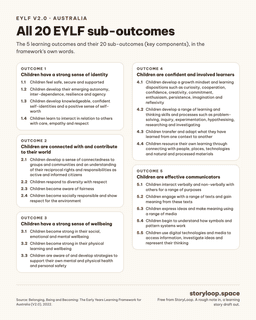
Usually one or two: the ones the moment genuinely shows. A story that links to all five reads like a checklist and tells a family less. Every example on this page links one outcome, and one of them adds a second.
Either. EYLF V2.0 has five learning outcomes, and each has key components that many educators call sub-outcomes, 20 in all. Naming the key component, such as 4.2, is more precise, but only when the moment clearly fits it. The outcome alone with a clear reason is still a sound link.
No. ACECQA says there is no one way to meet documentation requirements, and assessors look for the assessment and planning cycle, not a template. Observation, what learning you noticed, outcome links, where to next and family voice is a common shape, and it is the one used on this page.
Either is fine, and it is a choice for your service. Writing about the child ("Mia served her own rice") suits a story that sits in a portfolio beside your analysis. Writing to the child ("Mia, you served your own rice") reads warmly when the story is shared with the child and the family. The examples here are written about the child.
Yes. Type or say your quick note and StoryLoop drafts the learning story with the EYLF V2.0 outcomes the moment actually shows, keeps the child's words exactly as you wrote them, and adds where to next and a family link. You can try it on this page without signing up, it is free for 3 stories a month, and you check every word before anything is shared.
No. StoryLoop supports drafting and structure, while educators remain responsible for observation, interpretation, reflection, final editing, and sign-off.
Yes. Stories are editable after generation and saved in history, so educators can add context, adjust wording, copy, export, or regenerate from the original observation.
StoryLoop is designed to avoid generic, poetic AI wording. It asks for real observations, keeps claims evidence-based, and links curriculum only when the observation supports it.
The free plan includes 3 learning stories per month. Upgrade prompts are dismissible, and existing history remains available even if the free limit is reached.